
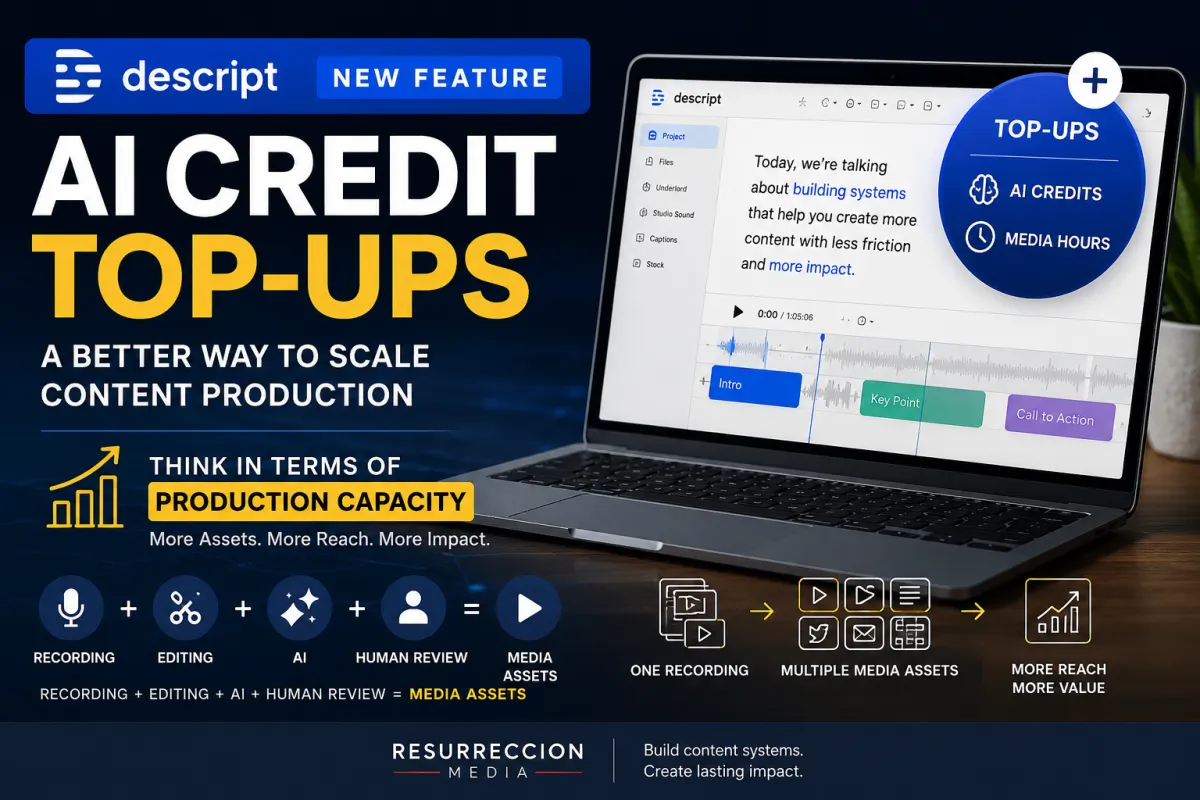
Descript Just Made Scaling AI Editing Easier: What Their New Top-Up System Means for Media Departments
Every growing content business eventually reaches the same challenge.
Recording more content is rarely the problem. Publishing it consistently is.
Videos sit unedited. Podcasts wait for review. Social clips never make it to the publishing calendar. Marketing teams find themselves working harder while producing fewer finished assets than expected.
These bottlenecks rarely happen because people lack ideas. They happen because production capacity reaches its limit.
At Resurreccion Media, we've spent a great deal of time studying this problem. Instead of viewing every recording as a single video, we've redesigned our production workflow around a different idea.
Every long-form recording is the starting point for an entire library of future media assets.
One interview can become multiple podcast episodes, YouTube videos, short-form clips, blog articles, newsletters, social posts, and educational resources. The recording is only the beginning. The real opportunity comes from everything that follows.
That philosophy has shaped the way we evaluate editing software, production systems, and automation. It also led us to document our own experiments, including one where we intentionally consumed 1,048 AI Credits to better understand how production resources translate into business outcomes.
Along the way, we discovered something that changed how we think about editing.
The real investment isn't AI credits.
It's production capacity.
That idea makes Descript's new AI Credit and Media Hour Top-Ups much more significant than they first appear.
At first glance, the update looks like a billing feature. In practice, it gives businesses another way to protect production capacity when workloads temporarily increase.
Understanding that difference changes how many business owners evaluate both the software and the economics behind modern content production.
Proof From Real-World Experience
One pattern has repeated itself throughout nearly every workflow experiment we've conducted.
Businesses rarely create better results simply by adding more resources.
They create better results when the resources they already have are used with greater intention.
That became increasingly clear during our 1,048 AI Credit experiment.
The purpose of the experiment was never to consume as many credits as possible. Instead, each prompt became an opportunity to understand how different workflows affected the quality and quantity of finished media assets.
Some prompts delivered immediate value.
Others revealed better production systems that continued creating value long after the experiment ended.
The lesson extended far beyond AI credits.
Every production input, recording time, editing, review, automation, and publishing, became easier to evaluate because each one could be measured against the media assets it helped create.
We also observed another consistent pattern.
When production systems are not clearly defined, distribution begins to suffer first.
Content misses publishing schedules. Social channels become inconsistent. Valuable recordings remain unfinished because the workflow cannot keep pace with production.
Improving the underlying system tends to correct these problems more effectively than simply working longer hours.
That observation continues to shape how we evaluate every production tool we add to our workflow.
What Is Descript?
For readers who are new to the platform, Descript is much more than a traditional video editor.
Most editing software asks creators to work directly on a timeline, trimming clips frame by frame while moving audio and video independently.
Descript approaches editing differently.
Instead of editing the timeline first, users edit the transcript.
Delete a sentence from the text, and the corresponding video section disappears automatically.
Correct spoken words, and the transcript updates with the recording.
This text-first workflow dramatically reduces the amount of manual editing required for podcasts, interviews, webinars, educational videos, and long-form conversations.
The platform also includes several tools that extend beyond basic editing.
Studio Sound enhances audio quality.
Filler words can be removed with minimal effort.
Underlord assists with production tasks like identifying potential social clips and organizing longer recordings into smaller content opportunities.
For entrepreneurs, consultants, educators, agencies, and personal brands, these tools help reduce the amount of manual work required after recording.
That efficiency is one of the primary reasons Descript has become the editing platform we rely on every day.
Why This Update Matters
Before this update, reaching your monthly usage limits often created an uncomfortable decision.
Production could pause until the next billing cycle.
Or the entire subscription plan needed to be upgraded, even if the increased workload was only temporary.
Neither option reflected how most businesses actually operate.
Content production is rarely identical every month.
Some months involve launching a podcast.
Others include recording an online course, producing client projects, or creating an entire library of marketing assets over a short period.
Workloads naturally fluctuate.
Descript's new Top-Up system recognizes that reality.
Instead of forcing creators to wait or permanently upgrade their subscription, businesses can now purchase additional AI Credits or Media Hours only when production temporarily exceeds their monthly allocation.
On the surface, this appears to be a billing improvement.
Viewed through the lens of production systems, however, it becomes something more valuable.
It helps protect momentum.
The Difference Between Buying Credits and Buying Capacity
This distinction changed the way we evaluate AI-powered editing.
Many creators naturally ask a simple question.
"How many credits will this cost?"
It's a reasonable question.
But over time, we found ourselves asking something different.
"What production capacity does this create?"
Those questions sound similar.
They lead to very different decisions.
One focuses on minimizing expenses.
The other focuses on increasing output.
Imagine two businesses that spend exactly the same amount on editing resources.
The first business uses those resources to publish one finished video.
The second uses the same investment to produce a long-form episode, six social clips, a blog article, an email newsletter, and several educational posts.
The spending is identical.
The production capacity is not.
That's why evaluating AI credits in isolation can become misleading.
Credits are only one ingredient inside a much larger production system.
The real objective is not consuming fewer credits.
The objective is creating more valuable media assets from every recording.
The Content Production Equation
During our workflow experiments, we gradually simplified content production into a framework that continues guiding our decisions.
Recording + Editing + AI + Human Review = Media Assets
Each part of the equation represents a production input.
Recording creates the raw material.
Editing organizes the message.
AI accelerates repetitive work and surfaces opportunities that might otherwise remain hidden.
Human review protects quality, context, and accuracy before publication.
When these inputs work together efficiently, they produce valuable outputs.
Those outputs are the assets that continue creating value long after recording ends.
Examples include:
Long-form videos
Podcast episodes
Short-form clips
Blog articles
Email newsletters
Social media content
Educational resources
Sales enablement content
Notice that none of these outputs exist because of AI alone.
They exist because multiple production inputs work together inside a repeatable system.
That distinction matters.
Businesses often spend significant energy trying to reduce one input while overlooking opportunities to improve the entire production equation.
In practice, the greatest leverage usually comes from improving the system itself rather than optimizing one isolated variable.
Understanding Descript's New Top-Up System
With that framework in mind, Descript's latest update becomes easier to understand.
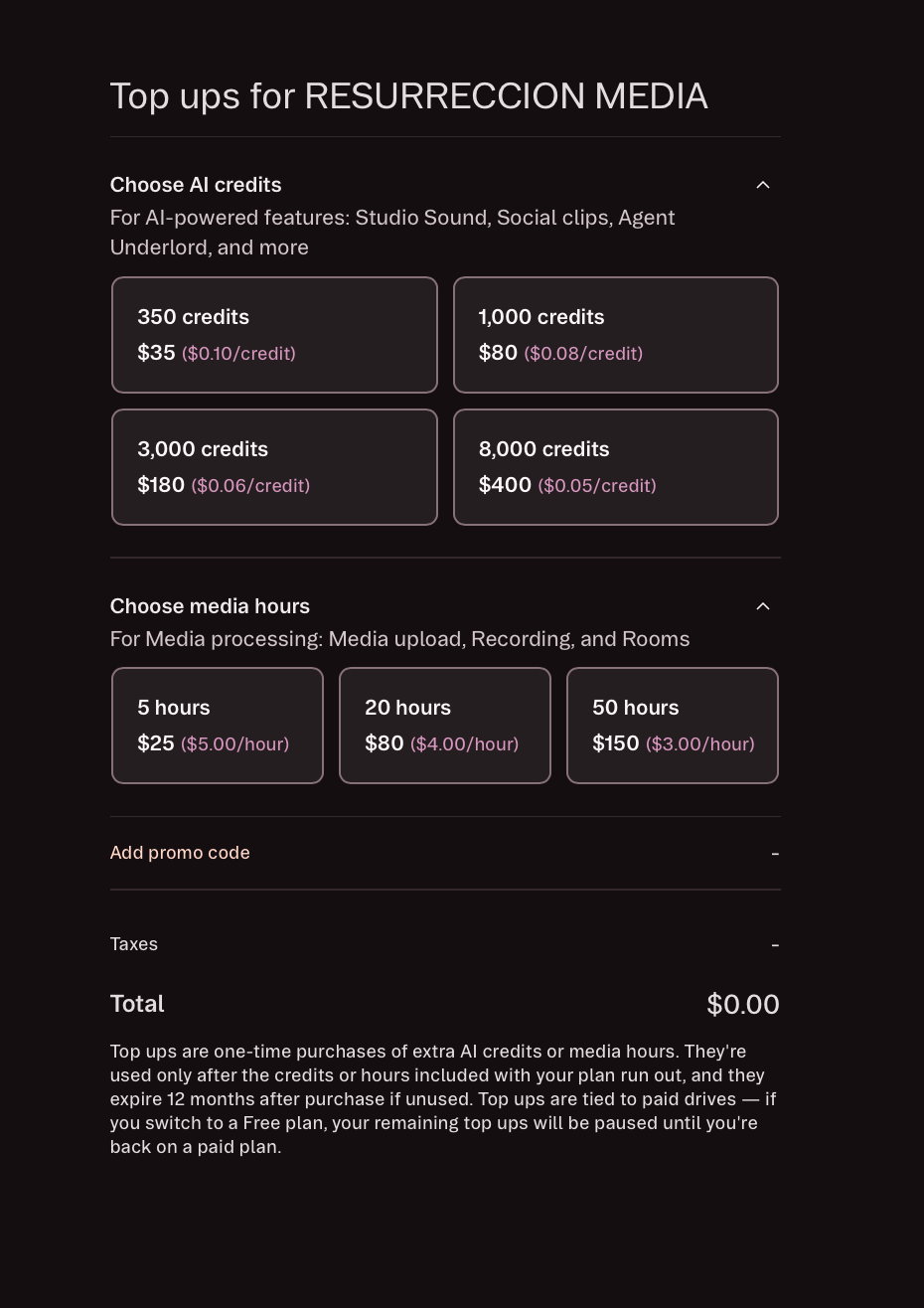
The platform now allows users to purchase one-time bundles of additional AI Credits and Media Hours whenever production temporarily exceeds the limits included in their subscription.
For AI Credits, larger bundles reduce the effective cost per credit.
The same principle applies to Media Hour bundles, with larger purchases lowering the cost per hour.
The mechanics are straightforward.
The strategic implication is more interesting.
Instead of allowing production to slow because an allocation has been exhausted, businesses now have another option for maintaining workflow continuity during periods of increased demand.
That flexibility may not seem dramatic at first glance.
For organizations producing content consistently, however, protecting production momentum often creates far more value than delaying work while waiting for the next billing cycle.
More importantly, it reinforces a broader lesson we've continued observing throughout our own experiments.
The most valuable production systems are designed around removing bottlenecks.
Every bottleneck removed allows more finished media assets to move through the pipeline.
And every additional media asset represents another opportunity to educate, build trust, and reach new audiences.
Why AI Credits Are Better Viewed as Production Inputs
One of the biggest lessons from our 1,048 AI Credit experiment had very little to do with the number itself.
The more interesting discovery came from understanding why those credits were being used.
Every prompt represented a small investment into the production process.
Sometimes a prompt generated social clips that were ready for review.
Other times it revealed a better prompt, a better workflow, or a more efficient way to organize content.
Not every request created immediate value.
Many created future value.
That distinction matters.
Businesses make investments every day that don't produce instant results. Employees receive training before their productivity improves. Equipment is purchased before it generates revenue. Marketing campaigns often require time before producing qualified leads.
Content production follows the same pattern.
Every recording, editing session, review cycle, and AI-assisted task becomes part of the production process. Looking at one input in isolation rarely tells the whole story.
The more useful question becomes:
How many valuable media assets did this investment help create?
Once that question becomes part of the workflow, AI credits stop feeling like unpredictable expenses.
They become measurable production inputs.
Measuring Production Capacity Instead of Production Costs
Every business tracks inputs and outputs.
A manufacturer tracks raw materials.
A restaurant tracks food costs.
A construction company tracks labor and equipment.
Content businesses also have production inputs, even if they look different.
Common inputs include:
Recording time
Editing time
AI Credits
Human review
Publishing resources
The outputs are the media assets created from those resources.
Examples include:
YouTube videos
Podcast episodes
Short-form clips
Blog articles
Email newsletters
Landing page content
Sales resources
Social media posts
The objective isn't eliminating production inputs.
Every business requires them.
The objective is producing more valuable outputs from the same or similar level of investment.
Imagine recording a one-hour podcast.
One workflow publishes only the full episode.
Another workflow produces:
One YouTube video
One podcast episode
Eight social clips
One SEO blog article
One newsletter
Several LinkedIn posts
Multiple quote graphics
Future training material
The recording time never changed.
The production capacity did.
That is where the real leverage exists.
A Simple Framework for Evaluating AI Editing
Throughout our experiments, we've found it helpful to think about every production decision through one simple question:
Does this increase production capacity?
That question changes how software is evaluated.
Instead of asking whether a feature saves five minutes, it becomes easier to see whether it helps produce another valuable asset.
Instead of asking whether AI consumed twenty credits, the focus shifts toward whether those credits eliminated repetitive work or uncovered content opportunities that otherwise would have remained hidden.
This creates a different way of evaluating return on investment.
Rather than measuring software by the cost of individual actions, it becomes possible to measure software by the amount of production it enables.
That perspective often leads to better long-term decisions because businesses begin optimizing the entire production system instead of individual tasks.
How Top-Ups Protect Production Capacity
Viewed through this framework, Descript's new Top-Up system becomes much easier to appreciate.
Imagine a team preparing for a product launch.
Several interviews have been recorded.
The editing queue is full.
Blog articles need to be published.
Social clips are scheduled over the next several weeks.
Then the monthly AI allocation runs out.
Under the previous model, production often slowed while waiting for the subscription to renew or until the plan was upgraded.
Now there is another option.
Additional AI Credits or Media Hours can be purchased for temporary production spikes without changing the entire subscription.
That flexibility protects something much more valuable than credits.
It protects momentum.
Momentum is one of the most overlooked assets inside a content business.
When production stops, distribution slows.
Publishing calendars become inconsistent.
Marketing campaigns lose rhythm.
Audience expectations begin to drift.
We have consistently observed that distribution is usually the first area affected when production systems become strained.
Improving the workflow almost always improves distribution because more finished assets continue moving through the publishing pipeline.
That is why protecting production capacity often creates benefits that extend well beyond the editing process itself.
Strategic Insight: The Most Valuable Asset Isn't AI
It is tempting to believe that better technology automatically produces better content.
Our experience suggests something different.
Technology amplifies systems.
Strong systems become faster.
Weak systems become faster at creating inconsistency.
The businesses that consistently produce high-quality content rarely depend on one feature or one platform.
They build repeatable workflows.
They document production standards.
They understand where bottlenecks appear.
They remove those bottlenecks one at a time.
Technology becomes valuable because it strengthens an already functional system.
That is exactly what our 1,048 AI Credit experiment reinforced.
The experiment was never about maximizing software usage.
It was about understanding how every production input contributes to a larger content ecosystem.
That understanding continues creating value long after the credits themselves were consumed.
Common Mistakes to Avoid
Measuring credits instead of outcomes
AI Credits only tell part of the story. The more meaningful measurement is the number of valuable media assets created from those credits.
Treating every recording as a single piece of content
Long-form recordings often contain dozens of future assets waiting to be discovered through an organized production workflow.
Optimizing individual tasks instead of the system
Saving a few minutes on one editing task creates limited value if the overall production pipeline remains inconsistent.
Allowing bottlenecks to interrupt distribution
Publishing consistency often declines before anyone notices problems inside the production workflow. Maintaining production momentum keeps distribution healthy.
Evaluating software only by subscription price
Software creates the most value when it expands production capacity and removes workflow constraints.
Frequently Asked Questions
What are Descript AI Credit Top-Ups?
Top-Ups allow users to purchase additional AI Credits when their monthly allocation has been exhausted. They are designed for temporary increases in production rather than permanent subscription changes.
What are Media Hour Top-Ups?
Media Hour Top-Ups provide additional upload, recording, and media processing capacity beyond the monthly amount included with a subscription.
Why is production capacity more important than minimizing AI Credits?
Businesses grow by creating valuable outputs. Measuring how many assets are produced from available resources often provides better insight than focusing on one production expense.
Can AI replace human editors?
AI accelerates repetitive tasks and assists with organization, but human review remains essential for maintaining quality, context, accuracy, and brand voice.
Why does workflow matter more than individual tools?
Every tool contributes to a larger production system. Well-designed workflows continue creating value regardless of which software performs individual tasks.
Who benefits most from Descript's Top-Up system?
Businesses that experience seasonal production increases, launch campaigns, client work, podcasts, educational content, or large recording sessions gain additional flexibility without permanently changing subscription plans.
Final Thoughts
Descript's new Top-Up system is easy to describe as a billing feature.
In practice, it represents something much more important for businesses that produce content consistently.
It gives creators another way to protect production capacity during periods of increased demand without interrupting the workflow they've already built.
That distinction changes the conversation.
The real question is no longer, "How can I use fewer AI Credits?"
A more useful question becomes:
"How can I create more valuable media assets from every production input?"
Those questions lead to different decisions.
They encourage businesses to improve workflows instead of simply reducing costs.
They shift attention toward systems instead of isolated tasks.
Most importantly, they recognize that every recording has the potential to create far more value than a single finished video.
At Resurreccion Media, that philosophy continues shaping every experiment we conduct and every workflow we refine.
Our objective has never been to produce more content for the sake of producing more content.
It has always been to build systems that transform every recording into as many high-quality media assets as possible.
Descript remains one of the most valuable tools helping us accomplish that goal. Not because it replaces the work, but because it expands the production capacity of the system around it.
Continue Reading
If you'd like to learn more about the production system behind our workflow, these articles provide additional context:
Why Descript Is the #1 Video Editing Software for Entrepreneurs and Personal Brands (And Why Resurreccion Media Runs on It)
https://resurreccionmedia.com/post/descriptWe Spent 1,048 AI Credits to Discover a Better Content System
https://resurreccionmedia.com/post/1048-ai-credits-content-production-system
Streamline Your Content Production
If you're looking for an editing platform that makes it easier to turn one recording into multiple media assets, Descript is the platform we use every day to power the Resurreccion Media production system.
Use our affiliate link below to learn more and see whether it fits your workflow.
New users receive 50% off the Creator Monthly Plan for two months when signing up through our affiliate link.
Try Descript here:
https://descript.cello.so/X8bhxP7pcbM
Need Help With Your Specific Situation?
If you'd like Resurreccion Media to evaluate your content production system and identify opportunities to improve capacity, reach out to us. We help founders, service businesses, creators, and growing companies build content marketing systems that produce consistent, scalable results.
Take the Free Growth Scorecard
Discover the bottlenecks limiting your business and receive a free business audit after completing the assessment. The scorecard takes less than five minutes to complete.
(Click here to get your Scorecard)
Subscribe to Our YouTube Channel
We publish straightforward videos that help business owners build better marketing systems, improve content production, and grow with clarity.
Find us at @resurreccionmedia.


