
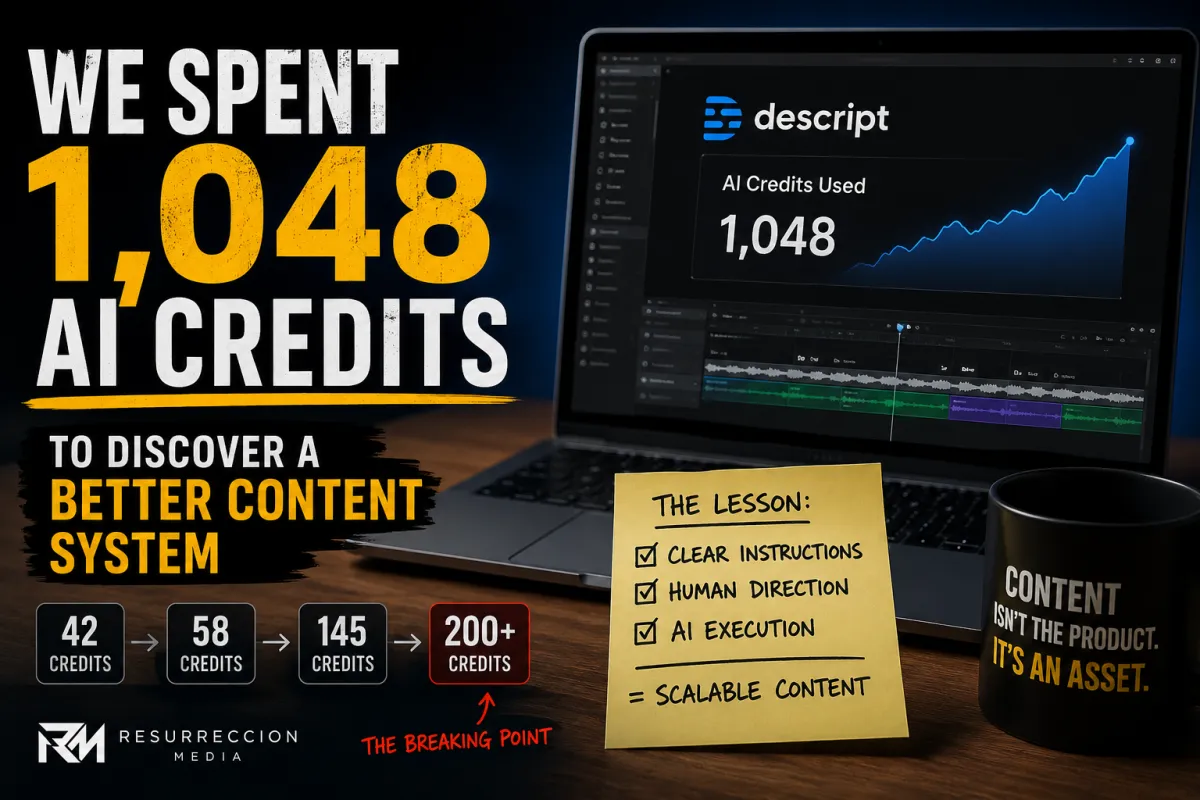
We Spent 1,048 AI Credits to Discover a Better Content System
Creating more content is rarely the hardest part of content marketing. The real challenge is building a system that turns every piece of content into as many valuable assets as possible without sacrificing quality.
That question led us to one of the most valuable experiments we've run at Resurreccion Media. What started as an effort to automate podcast editing became a much bigger lesson about production systems, AI workflows, and why the best content strategy often begins with content you already own.
Proof From Real-World Experience
For several weeks, our team focused on redesigning our internal production pipeline. The goal was never to edit a single podcast faster. The goal was to discover whether one long-form recording could consistently produce dozens of high-quality media assets through a repeatable system.
As the experiment progressed, one pattern became impossible to ignore. The more decisions we asked AI to make on its own, the more expensive the process became. Credit usage climbed from dozens to well over one hundred during individual workflows. Eventually, the conversation shifted away from editing altogether.
The turning point came when we stopped asking how to create more clips and started asking whether we were solving the right problem. That question changed the direction of the entire project.
Instead of building a system that depended on AI making creative decisions, we began designing one where people provide the direction and AI executes clear instructions. That shift became the foundation for a more scalable production workflow.
Why This Experiment Started
Many businesses believe their biggest content problem is creating enough material.
Our experience pointed somewhere else.
Every long-form recording already contains far more value than most companies ever extract.
One interview can become:
A full-length episode
Short video clips
Elite micro clips
Blog articles
Newsletters
Social media posts
Email campaigns
Educational resources
Sales content
The recording is only the starting point.
The real opportunity comes from treating every recording as a library of assets waiting to be organized, refined, and distributed.
That realization changed how we think about content production.
Content is not the final product.
Content is an asset.
Once that mindset changes, the conversation changes too. Instead of asking how to produce more content, the focus becomes how to unlock more value from every piece already created.
Why We Chose FIREHOUR
Over the years, FIREHOUR has grown into a large collection of conversations, insights, and evergreen education.
Like many businesses, we realized we already owned an extensive content library. Much of it remained valuable long after it was published.
Rather than recording entirely new material for every campaign, we asked a different question.
What if the greatest opportunity was hidden inside content we already owned?
That simple question became the mission.
Mine the archive.
Instead of treating old content as finished work, we began viewing it as raw material ready for new formats and new audiences.
The experiment was never about replacing creativity.
It was about improving leverage.
The Goal Was Never Ten Clips
Many people hear about automated editing and immediately think about generating more clips.
That was never our objective.
Our goal was to build an operating system.
Those are two very different goals.
Generating ten clips solves today's problem.
Building a repeatable system solves tomorrow's problem, next month's problem, and next year's problem.
Throughout the experiment, we weren't measuring views or likes.
We were measuring different outcomes.
How many assets could one recording produce?
How many AI credits were required?
Which steps repeated every time?
Which parts required human judgment?
Which tasks could become standardized?
Those questions created a much more valuable discussion than simply counting finished videos.
Every answer moved us closer to a production system instead of a one-time workflow.
The Breaking Point
Every experiment reaches a moment where assumptions meet reality.
Ours happened while reviewing AI credit usage.
At first, the numbers seemed reasonable.
42 credits.
Then 58.
Then 145.
Eventually, the number climbed beyond 200.
Instead of celebrating automation, we stopped and asked a much more important question.
Were we optimizing the wrong thing?
That single conversation changed everything.
The issue was not the software.
The issue was the workflow.
We had designed a process that asked AI to analyze, interpret, prioritize, decide, and execute all at once.
Each additional decision increased the work being performed.
The more responsibility we handed to AI, the more resources it consumed.
That realization became the emotional turning point of the experiment.
Reading the Documentation Changed Everything
Rather than guessing why costs continued to increase, we went directly to the documentation.
One explanation stood out immediately.
The platform wasn't simply charging for editing.
It was charging for both the intelligent agent and the AI tools the agent used to complete each task.
That distinction completely changed how we viewed AI-assisted editing.
Every decision has a cost.
Every layer of reasoning requires additional work.
The lesson extended far beyond a single platform.
It changed how we evaluate every AI workflow.
The Bigger Lesson About AI
The experiment stopped being about editing software.
It became a lesson about AI itself.
Across almost every modern AI platform, one pattern continues to appear.
AI performs exceptionally well when executing clear instructions.
Costs increase when AI must determine the instructions on its own.
That principle applies across many tools.
Whether someone uses language models, coding assistants, automation platforms, editing software, or business workflows, the same tradeoff often appears.
Decision-making is expensive.
Execution is efficient.
The better the instructions become, the more predictable the outcome becomes.
This idea also extends beyond technology.
Employees perform better with clear expectations.
Contractors perform better with defined deliverables.
Processes improve when every participant understands their role.
Systems become more scalable when fewer decisions happen during execution.
AI simply makes this principle easier to observe.
The Future Workflow
The experiment also revealed a better production model.
Instead of asking AI to discover every opportunity from beginning to end, the workflow becomes much more intentional.
Transcript
↓
Identify potential opportunities
↓
Human review
↓
AI execution
↓
Distribution
This sequence creates a healthier balance between strategy and automation.
People provide context.
AI handles repetitive execution.
The result is greater consistency, lower costs, and workflows that become easier to improve over time.
Instead of rebuilding the process for every new recording, the same operating system can support hundreds of future projects.
That is where scale begins.
Why This Matters for Business Owners
Many founders believe they have a content problem.
Often, they have a systems problem.
One business may publish hundreds of videos without a repeatable workflow.
Another may publish only a handful while extracting every possible asset from each recording.
The second business frequently gains more long-term value because every piece of content continues working long after production ends.
The difference is not volume.
The difference is organization.
Strong systems allow businesses to:
Repurpose existing content consistently.
Reduce unnecessary production work.
Improve quality through repeatable processes.
Create predictable publishing schedules.
Build assets that compound over time.
The content library becomes more valuable because every recording continues creating opportunities instead of remaining a finished project.
Why We Still Recommend Descript
This experiment was never about proving that a platform was too expensive.
In fact, the software performed exactly as designed.
The real lesson came from understanding our own workflow.
We asked AI to make too many decisions.
The platform responded accordingly.
Once we understood how the system operated, the conversation changed.
Instead of expecting automation to replace strategy, we began designing workflows where strategy happens first and automation follows.
That distinction made the platform far more valuable.
Technology rarely causes the biggest problems.
Workflow design does.
The Tool We Use
Despite burning through 1,048 AI credits during this experiment, we're still using Descript every day.
Why?
Because it helped us discover a better workflow.
If you're creating podcasts, YouTube videos, or short-form content, Descript remains one of the best editing platforms we've used.
New users receive 50% off the Creator Monthly Plan for two months when signing up through our affiliate link.
Try Descript here:
https://descript.cello.so/X8bhxP7pcbM
The Real Meaning Behind Clips At Scale
Weeks of experimentation.
More than 1,000 AI credits.
Countless revisions.
Several redesigned workflows.
None of that research was about creating a few better clips.
It was about building a production system capable of turning one recording into an entire content ecosystem.
That philosophy sits at the center of Clips At Scale.
Clients are not simply receiving edited videos.
They benefit from every lesson learned during the experiments that shaped the workflow.
They gain a system refined through testing, observation, iteration, and continuous improvement.
The result is more than content production.
It is a repeatable operating system designed to help businesses unlock more value from every conversation they record.
The biggest lesson from this experiment is surprisingly simple.
Most businesses already have more content than they realize.
The opportunity isn't hiding in the next recording.
It's often waiting inside the archive they already own.
When every piece of content becomes an asset instead of a finished product, growth becomes less dependent on creating more and more material. Instead, it becomes the result of a system that consistently uncovers value that was there all along.
Want the System Without the Trial and Error?
This experiment took over 1,000 AI credits to uncover what actually scales.
Most founders don't have the time or desire to spend weeks optimizing AI workflows.
That's exactly why we built Clips At Scale.
We don't just edit videos.
We engineer systems that transform one filming session into a consistent stream of branded short-form content designed to build authority, visibility, and clients.
Whether your goal is 20 clips per month or 75+, our team handles the strategy, editing, optimization, branding, and delivery so you can focus on leading your business.
Learn more about Clips At Scale or book a free strategy call:
https://resurreccionmedia.com/clips-at-scale
Common Mistakes to Avoid
Treating every recording as a finished product. Valuable ideas often remain unused after the first publication.
Expecting AI to replace strategic thinking. Automation performs best when the direction is already clear.
Measuring success only by views. Assets, repeatability, and efficiency often tell a more complete story.
Creating new content before reviewing existing content. Evergreen libraries frequently contain untapped opportunities.
Building workflows around tools instead of outcomes. The strongest systems begin with the objective, then select the technology that supports it.
Frequently Asked Questions
What is a content operating system?
A content operating system is a repeatable process that turns one piece of content into multiple assets through consistent workflows.
Why is long-form content valuable?
Long-form content contains many ideas that can be repurposed into different formats for different audiences.
Does AI replace human editors?
AI increases efficiency, but human judgment remains valuable for strategy, context, and quality control.
Why focus on existing content first?
Existing content often contains evergreen insights that can continue producing value without starting from scratch.
What creates scalable content production?
Clear processes, defined responsibilities, and repeatable workflows make it easier to produce high-quality assets consistently.
Need Help With Your Specific Situation?
If you want Resurreccion Media to evaluate your business and help identify your next opportunity for growth, reach out to us.
Take the Free Growth Scorecard
Get an instant score that reveals your biggest growth bottlenecks and highlights practical next steps. You'll also receive a free business audit after completing the assessment. The process takes less than five minutes.
(Click here to get your Scorecard)
Subscribe to Our YouTube Channel
We publish long form training videos that help entrepreneurs and business owners scale. You can find us at @resurreccionmedia.


