
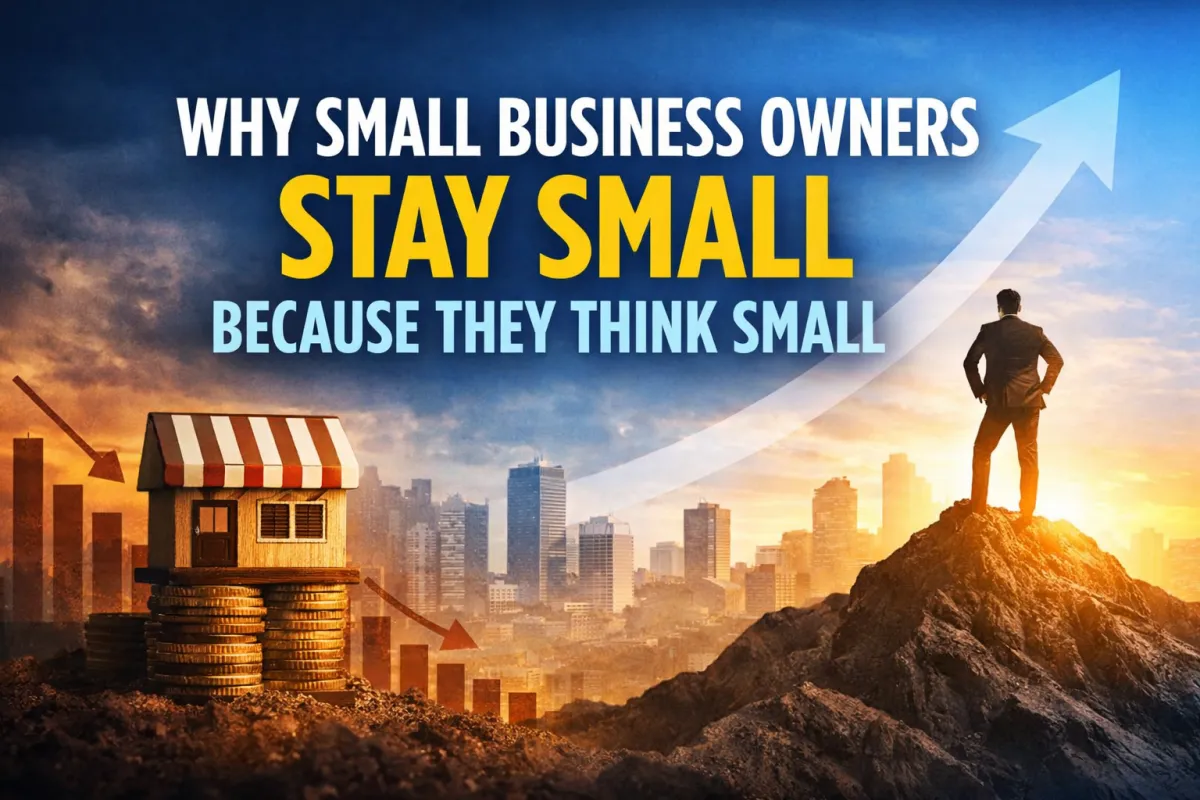
Why Most Small Business Owners Stay Small
Many small business owners work hard. They care about their customers. They want to grow.
Yet most stay small for years. Not because of the market. Not because of talent. But because of how they think.
This article explains why a small mindset keeps businesses small and what changes when the thinking changes.
Proof From Real-World Experience
In the real world, when business owners operate with a limited vision, growth slows down early. They stay busy, but the business does not expand in a meaningful way. The impact remains narrow. The reach stays local. The systems never fully mature.
Over time, this pattern becomes clear. Owners who think small protect what they have. They avoid risk. They avoid visibility. They avoid scale. As a result, they never build something that reaches more people or creates larger value for clients, the marketplace, or the economy.
A different pattern appears when thinking shifts. When a personal brand moved from quiet to visible, influence increased. The reach expanded. More people were helped. The value created in the marketplace grew. The change was not magic. It came from going bigger than before with bigger vision, bigger exposure, and bigger decisions.
Another pattern stands out. Staying small feels safe, but the long term risk grows. Growth carries discomfort. Staying small carries decay. Over time, the greater risk is often not expansion but stagnation.
These patterns repeat across industries.
What This Means
“Thinking small” does not mean having a small team. It does not mean starting with limited resources. Every large company once started small.
Thinking small is a mental frame.
It shows up like this:
Only serving what feels comfortable
Avoiding visibility
Keeping prices low out of fear
Refusing to systemize
Saying, “This is enough” too early
A small mindset focuses on survival. A growth mindset focuses on capacity.
A small mindset asks:
“What if this fails?”
A growth mindset asks:
“What becomes possible if this works?”
The size of a business rarely outgrows the size of the owner’s thinking.
If the owner sees the company as a side project, it behaves like one.
If the owner sees it as a long term asset, it starts to operate like one.
Thinking small limits:
Vision
Talent attraction
Systems
Revenue potential
Market impact
Thinking bigger expands all of those.
Why This Matters for Business Owners
Small thinking affects more than revenue. It affects structure.
When an owner thinks small:
Hiring is delayed
Marketing is inconsistent
Brand presence is weak
Pricing stays reactive
Systems never fully develop
The business becomes dependent on the owner’s time.
That creates a ceiling.
When thinking expands, structure changes.
Bigger thinking leads to:
Clear positioning
Intentional branding
Scalable systems
Defined offers
Long term planning
Growth becomes possible because the structure can hold it.
This matters for three key reasons:
1. Client Impact
A small operation can only serve a limited number of people.
A bigger structure serves more without lowering quality.
Impact scales when systems scale.
2. Economic Contribution
Small thinking limits job creation.
It limits innovation.
It limits value distribution.
When a business grows, it supports vendors, partners, employees, and clients at a higher level.
3. Personal Fulfillment
Owners who stay small often feel stuck. They work hard but do not feel momentum.
When the vision expands, energy changes. Direction becomes clearer. Effort becomes strategic.
Growth aligns effort with opportunity.
Step by Step Breakdown: How Small Thinking Shows Up and What Changes It
Step 1 Expanding the Vision Beyond Survival
Many businesses begin in survival mode. That is normal.
The shift begins when the owner stops asking, “How do I get through this month?” and starts asking, “What does this look like at scale?”
This changes decisions:
Pricing becomes value based
Marketing becomes consistent
Brand becomes intentional
A bigger vision forces better structure.
Step 2 Increasing Visibility
Small thinking hides.
Owners avoid:
Publishing content
Building a personal brand
Speaking publicly
Showing expertise
When visibility increases, opportunity increases.
The shift from being unknown to being recognized changes leverage. Influence compounds. Trust builds at scale. Value spreads further than direct outreach ever could.
Step 3 Investing in Systems
A small mindset runs everything manually.
A growth mindset builds:
Repeatable processes
Clear workflows
Documented operations
Systems allow scale without chaos.
When systems are missing, growth feels risky. When systems exist, growth feels manageable.
Step 4 Pricing for Capacity, Not Fear
Small thinking keeps prices low to avoid rejection.
Bigger thinking prices for sustainability.
When pricing aligns with value:
Margins improve
Delivery improves
Client quality improves
The business becomes stronger.
Step 5 Building an Asset, Not a Job
Small thinking builds income.
Bigger thinking builds assets.
An asset:
Has brand equity
Has recurring revenue
Has systems
Has team support
An asset can grow beyond the owner’s daily effort.
That shift changes everything.
Strategic Insight
The market rarely limits growth first. Mindset does.
Risk is often misunderstood.
Many believe growth carries danger. In reality, stagnation carries quiet erosion.
When a business stays small:
Competitors improve
Costs increase
Opportunities pass
Talent goes elsewhere
Over time, the gap widens.
Growth creates pressure. Pressure creates structure. Structure creates strength.
There is a pattern that holds up across industries:
Expansion creates capability.
Contraction preserves limitation.
Owners who consistently think bigger tend to build businesses that outlast competition and economic cycles. Not because they gamble but because they design for scale.
Going bigger is not reckless. It is intentional expansion backed by systems and clarity.
Staying small feels safe in the short term. Over time, it becomes the larger risk.
Section 5 Common Mistakes to Avoid
Confusing comfort with stability
Comfort feels safe. Stability comes from structure and growth.Believing small equals low risk
Small businesses face the same market pressures without the buffer of scale.Waiting to grow until “ready”
Readiness often comes after movement, not before.Avoiding brand visibility
Invisibility limits opportunity more than competition does.Underpricing to secure business
This creates fragile margins and long term stress.
FAQ
Why do small business owners struggle to grow?
Often, decisions are made from caution instead of capacity. Over time, that caps growth.
Is thinking bigger the same as taking reckless risks?
No. Bigger thinking focuses on structure, systems, and long term scale, not gambling.
Can a small business grow without a personal brand?
Growth is possible, but visibility increases leverage and opportunity significantly.
What is the biggest risk of staying small?
Over time, stagnation reduces relevance and impact.
Does every business need to become large?
Not every business becomes massive. But businesses built with expansion in mind tend to create more value, more stability, and more opportunity.
How does mindset affect revenue?
Mindset shapes pricing, marketing, hiring, and structure. Those decisions directly affect revenue potential.
Final Thoughts
Most small businesses do not stay small because of lack of effort. They stay small because of limited expansion in thinking.
When the mindset shifts, behavior shifts.
When behavior shifts, structure changes.
When structure changes, growth becomes possible.
The pattern is consistent:
Bigger thinking builds bigger capacity.
Bigger capacity creates bigger impact.
The ceiling is rarely the market.
It is usually the frame through which the owner sees it.
📩 Need Help With Your Specific Situation?
If you want Resurreccion Media to look at your business and give you clarity on your next step, reach out to us.
We help founders, service businesses, companies, and creators build content marketing systems that scale.
📊 Take the Free Growth Scorecard
Get an instant score that shows your bottlenecks and next moves.
You’ll get a free business audit the moment you finish.
It takes less than 5 minutes.
(Click here to get your Scorecard)
▶️ Subscribe to Our YouTube Channel
We post simple, clear videos that help business owners grow without confusion.
You can find us at @resurreccionmedia.


