
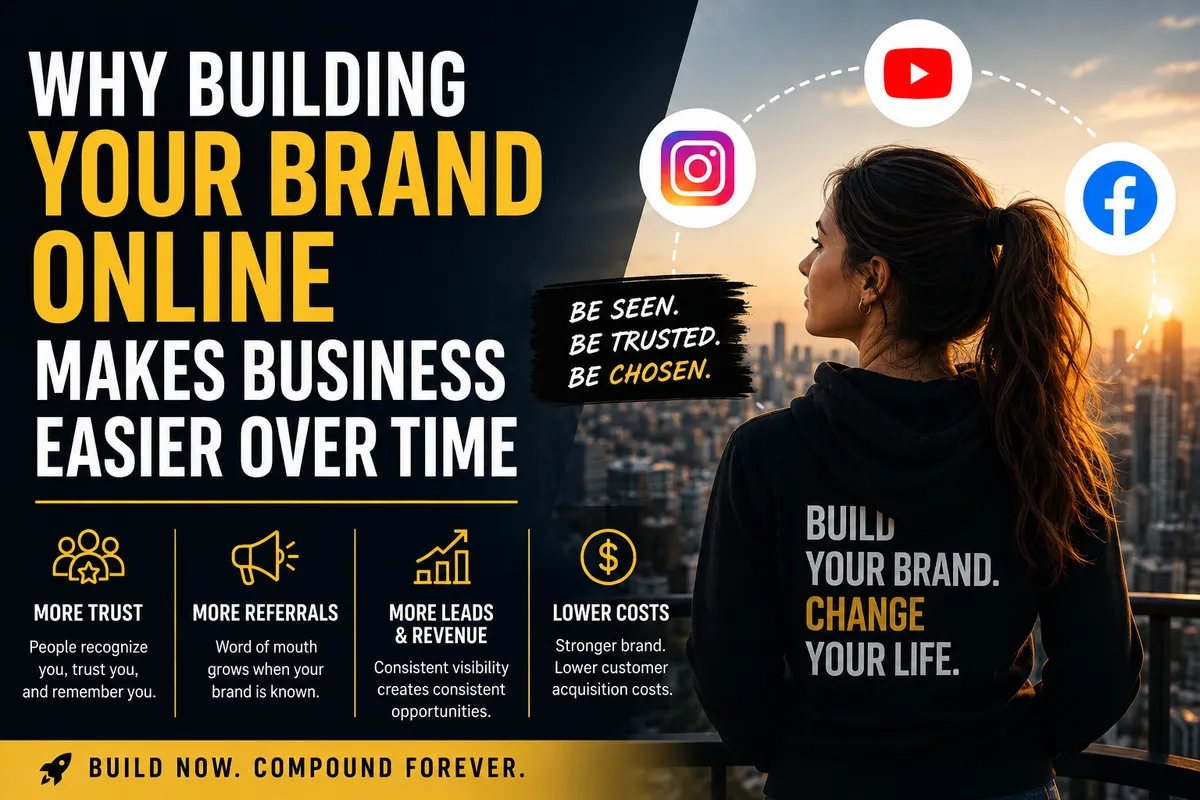
Why Building Your Brand Online Makes Business Easier Over Time
Word of mouth cannot be turned on with the flip of a switch. Trust cannot either. Both are built over time through repeated exposure, useful content, and a brand that keeps showing up where customers spend their attention.
That is why building a brand online matters for almost every business. Instagram, YouTube, and Facebook create a strong base for distribution. Other platforms can expand that reach depending on the business, the customer, and what the company can realistically execute.
The goal is not to be everywhere just to say the business is everywhere. The goal is to build a digital presence that compounds.
Proof From Real-World Experience
A clear pattern appears when a business keeps publishing useful content over a long period. Trust grows. More people know the name. Word of mouth increases. Leads begin coming from places that are harder to trace back to one ad, one post, or one campaign.
Over time, credibility can compound in the same way. A person may see a business on Instagram, later watch a YouTube video, hear the name from a friend, and eventually visit the company when a need appears. No single interaction created all of the trust. The collection of interactions did.
This also happens with personal brands. Years of publishing across Instagram, TikTok, Facebook, and YouTube can create recognition far beyond likes and views. People may recognize the person in public, ask business questions, request photos, discuss opportunities, or eventually become paying clients. Content becomes more than media. It becomes a record of expertise, ideas, and consistent presence.
A similar effect can happen beyond social platforms themselves. When a business has created a large public footprint across multiple places online, search and answer systems have more information available about the company. That visibility can create another path to discovery. In one observed business, that path resulted in real inquiries that became paying clients.
The important difference is rarely one viral post. It is the long-term system behind the brand.
What Building a Brand Online Really Means
An online brand is not a logo.
It is not a color palette.
It is not a large follower count.
A brand is the idea people connect with a business or person.
When someone hears a company name, something comes to mind. They may think the company is trustworthy. They may remember a useful video. They may connect the company with a certain service. They may remember seeing its content several times.
That memory has business value.
Content helps create those connections before a sales conversation happens.
Think about two businesses selling a similar service.
The first business has a basic website and rarely publishes anything.
The second has a useful website, hundreds of educational posts, videos answering customer questions, examples of its thinking, and a consistent presence across several platforms.
A potential customer hears both names.
The customer searches for each business.
The difference becomes clear very fast.
One business is asking the customer to trust it based mostly on what it says about itself. The other has built a public record that the customer can explore.
That is brand building in practice.
Brand Building Is Different From Chasing Attention
This distinction matters.
A piece of content can get a lot of views without building much brand value.
A funny video may reach thousands of people who will never buy. A controversial post may create comments without creating trust. A trend may produce a spike in traffic that disappears days later.
Attention has value, but attention alone is not the end goal.
For a business, useful content connects attention to a larger business strategy.
It helps the right person understand:
What the company does
Who it helps
What problems it understands
How it thinks
Why its approach is different
What it knows about the market
What someone can do next
This is where content moves from posting to marketing.
Why Online Brand Building Matters for Business Owners
Customer acquisition is one of the hardest parts of running a business.
Without a known brand, the business has to create attention again and again.
It may rely heavily on outbound sales, paid advertising, networking, direct messages, cold email, referrals, or other acquisition channels. Those methods can work, but the company often has to keep pushing to create the next opportunity.
A strong brand changes the environment around those activities.
People begin arriving with context.
They have already watched the videos.
They have already read the posts.
They have already seen the company several times.
They may have heard about it from someone else.
The sales conversation starts at a different point.
Instead of asking, "Who are you?" the prospect may already be asking, "How can we work together?"
That is a major difference.
Word of Mouth Gets Stronger When the Brand Is Easy to Find
Word of mouth is powerful because trust moves from one person to another.
But referrals do not always turn into customers.
Someone might say, "Talk to this company."
The prospect still searches the name.
What happens next matters.
A strong online presence supports the referral. The prospect sees content, videos, ideas, examples, and a consistent message. The recommendation from a friend now has a second layer of credibility.
A weak online presence can create the opposite effect.
The recommendation may be strong, but the digital footprint gives the prospect little reason to keep exploring.
This is one reason online brand building and word of mouth work well together.
Content does not replace word of mouth.
It strengthens it.
Brand Can Lower the Pressure on Customer Acquisition
As recognition grows, a business can become less dependent on constantly introducing itself to new people.
This does not mean customer acquisition disappears.
It means the brand begins helping with the work.
Content gets shared.
Old videos keep getting discovered.
Customers mention the company.
People remember the name.
Searchers find the business.
Past followers become future buyers.
Prospects arrive after consuming months or years of published material.
That can make acquisition more efficient over time. A known brand often has an advantage because the customer does not begin from zero trust.
This is also why brand building can support market share. The company occupies more mental and digital space in its category.
A Step-by-Step Breakdown of Building an Online Brand
There is no single platform or post that creates a durable brand. The process works through repeated actions that connect to one larger strategy.
1. Start With a Clear Business Goal
Content works differently when the goal is clear.
A company trying to attract local service customers needs a different content system from a creator selling education. A business trying to establish authority in a narrow market needs different campaigns from a consumer company seeking broad awareness.
The business goal gives the content direction.
Without that direction, teams often default to whatever gets the easiest reaction.
Views become the goal.
Followers become the goal.
Posting becomes the goal.
But none of those automatically creates revenue.
A stronger system connects content to business outcomes.
2. Build Around the Customer
Useful brand content begins with the customer.
What does the customer want?
What problems keep appearing?
What questions come up before buying?
What misconceptions slow down a decision?
What does the customer need to understand before the company's offer makes sense?
These questions can become content campaigns.
One topic can become a YouTube video. That video can produce shorter clips. Those clips can be distributed on Instagram, Facebook, TikTok, and other relevant channels. The main idea stays consistent while the format changes.
The business is no longer inventing random posts every day.
It is building a body of work around the problems it wants to be known for solving.
3. Establish Core Platforms
Instagram, YouTube, and Facebook create useful starting points because they support different forms of content and discovery.
A business may add other platforms based on its market.
The larger principle is more important than the exact list.
A business benefits from having more than one place where customers can discover and verify it.
But trying to execute ten platforms badly can create more noise than value.
A realistic system comes first.
Three well-run channels can create more value than ten abandoned profiles.
4. Publish and Distribute Consistently
Publishing is only part of the process.
Distribution matters too.
A strong idea does not have to live in one place.
A long video can produce several short videos. A useful explanation can become a written post. A customer question can become an FAQ. A strong topic can become an article. Related ideas can become a content series.
This increases the useful life of each idea.
It also creates repeated exposure.
A customer may miss the first post and see the third. Another may find the YouTube video months later. Someone else may receive a Facebook post from a friend.
The brand grows through these repeated contacts.
5. Optimize for Trust, Not Only Reach
Reach tells a business how far content traveled.
It does not tell the entire story.
A smaller piece of content seen by the right buyers can create more business value than a viral post seen by people who have no connection to the offer.
This changes what success looks like.
The business begins paying attention to qualified conversations, inbound inquiries, referrals, sales opportunities, customer questions, and signs that the market understands what the brand represents.
Views still matter.
They simply become one signal instead of the whole strategy.
6. Give the System Enough Time to Compound
Brand building often looks slow before it looks powerful.
The first posts may receive little attention.
The first videos may have few viewers.
Recognition may be hard to measure.
Then the library grows.
There are dozens of videos instead of three. Hundreds of posts instead of ten. Search results contain more information. Customers have more material to share. Prospects can spend hours learning from the business before ever making contact.
Each new piece adds to what already exists.
That is the compounding effect.
The Strategic Insight: Build an Asset, Not a Feed
The most important shift is viewing content as an asset rather than a daily posting obligation.
A feed disappears quickly from attention.
A brand stays in memory.
Businesses focused on short-term wins often ask, "How many views did this get?"
Businesses building for the long term ask a larger question:
"Did this make our brand stronger?"
That question changes the content.
It favors useful ideas over empty trends.
It favors consistency over random bursts.
It favors clear positioning over trying to appeal to everyone.
It favors the right audience over the largest possible audience.
And it favors systems that can keep operating for years.
The long-term result is not simply more content.
It is greater trust.
That trust can turn into referrals, leads, partnerships, opportunities, sales, and customer loyalty.
It can also make other marketing channels work better because the market already has context about the company.
Common Mistakes That Weaken Online Brand Building
Optimizing only for virality.Large view counts can feel productive while attracting people who have little connection to the business.
Posting without a marketing strategy.Random content creates random results. Clear campaigns connect what gets published to the customers and outcomes that matter.
Trying to dominate every platform immediately.Too many channels can break execution. A smaller set of consistently managed platforms creates a stronger foundation.
Stopping before the brand compounds.Early results rarely show the full value of a content library. The advantage becomes clearer as useful content and market recognition accumulate.
Treating every platform as a separate job.One strong idea can often be adapted and distributed across several channels. A content system makes that process far more efficient.
Frequently Asked Questions
Does every business need an online brand?
For most businesses, customers now have opportunities to research a company before making contact. A useful online presence gives them more context and more ways to build trust.
Which platforms matter most for building a brand?
Instagram, YouTube, and Facebook create a strong base for many businesses. Other platforms become useful based on where the target customer spends time and what type of content the company can consistently produce.
Does a business need to be on every platform?
Being discoverable in more places can strengthen a digital footprint, but execution matters. A business that can consistently manage a few channels has a stronger starting point than one creating weak or abandoned accounts everywhere.
How long does brand building take?
Brand is built through repeated exposure, useful content, customer experiences, and consistent delivery. There is no single post or fixed timeline that creates trust.
Is going viral good for a business?
It can be. The bigger question is whether the attention reaches the right people and strengthens what the business wants to be known for. Reach without relevance can create activity without meaningful business results.
Can content generate customers without paid advertising?
Content can create inbound leads, referrals, direct inquiries, and sales opportunities. Its effectiveness depends on the offer, market, strategy, distribution, consistency, and quality of the content system.
Why does brand make selling easier?
Familiarity reduces the amount of explaining required at the start of a relationship. A prospect who has watched several videos or followed a business for months may already understand its expertise and point of view before making contact.
What is the difference between content creation and brand building?
Content creation produces media.
Brand building uses media to create a clear and lasting idea in the customer's mind.
That difference is critical.
A company can publish every day without building a strong brand. A real brand system connects the content, message, customer, offer, and business goal.
The Long-Term Advantage of Being Known
A business can buy attention.
It cannot instantly buy years of familiarity.
That is what makes brand valuable.
Every useful video, article, post, customer interaction, and referral can add another layer to how the market understands the company.
At first, the effect may be difficult to see.
Over time, people begin recognizing the name.
They share the content.
They ask questions.
They mention the business to friends.
They approach the company about opportunities.
Some become clients.
The business becomes easier to discover and easier to trust.
That is why online brand building is not simply a social media task.
It is a long-term business asset.
The companies that understand this do not build their entire strategy around the next viral post. They build a system that can keep publishing, distributing, teaching, and reinforcing the brand.
Start with the platforms the business can realistically execute well.
Build the system.
Keep the message connected to the customer.
Let the body of work grow.
Word of mouth cannot be turned on with a switch.
But a business can build the conditions that make more people want to talk about it.
Need help with scaling your business?
If you want Resurreccion Media to look at your business and give you clarity on your next step, apply for Private Advisory. We help 7-9 figure founders and companies scale.
Take the Free Customer-Worth Calculator
Three numbers show what one customer is really worth to your business, and what consistent content could add. Run your numbers here.
Subscribe to Our YouTube Channel
We post simple, clear videos that help business owners grow without confusion. You can find us at @resurreccionmedia.


