
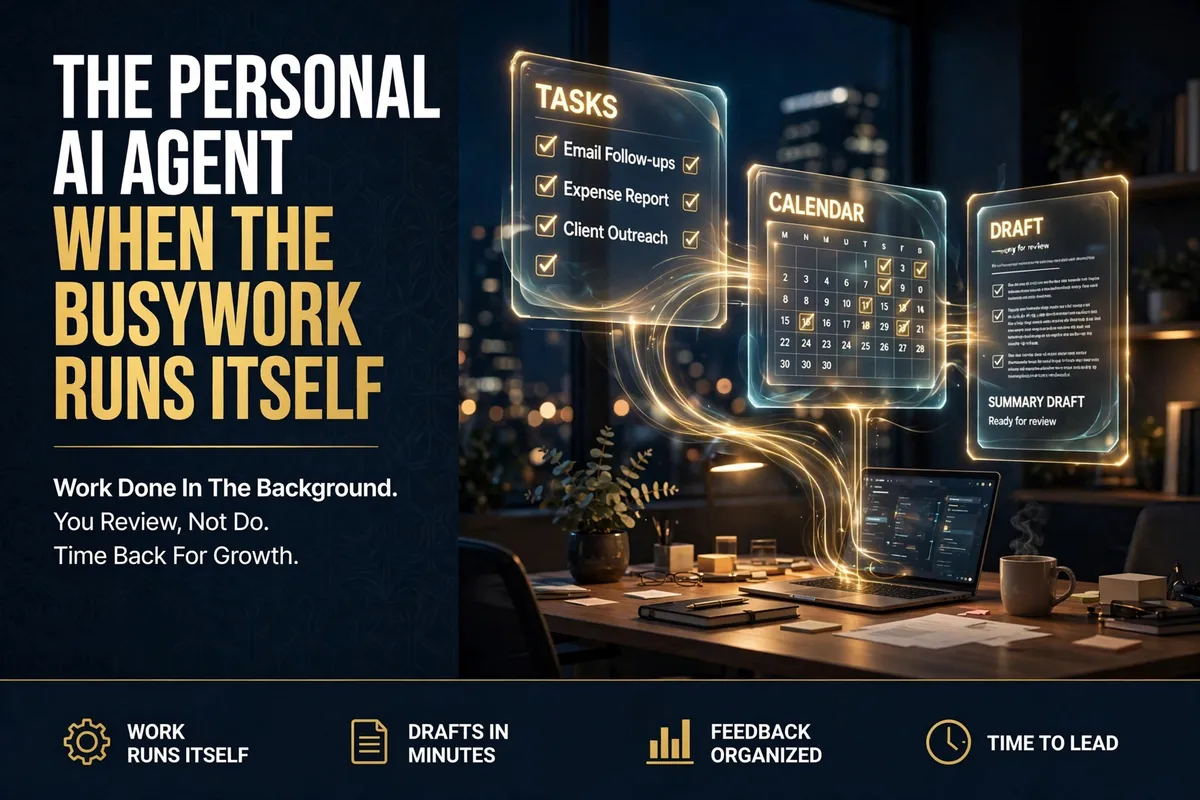
The Personal AI Agent: What Changes When the Busywork Runs Itself
A personal AI agent is software that does real work for a business owner. It handles research, writing, follow-up, and organization in the background. This article explains what that looks like in practice, why it matters for owners, and how operators start.
Proof From Real-World Experience
In practice, two types of business owners show up. The first stays buried inside the business and never tests anything new. There is no time to test, so nothing changes. The second places small strategic bets. They run an experiment, look at the data, and keep what works.
The owners who test tend to find the same thing. Workflows built with AI agents cut costs and save time. They remove overhead that used to require a full-time person. Tasks that once needed a human employee now run as a system in the background.
The clearest wins show up in content and feedback. Script writing, carousels, and research get drafted in minutes instead of hours. Real customer feedback and data get pulled from social platforms and organized into something useful. When feedback arrives in real time, strategy pivots in real time. Customer and market concerns get solved faster.
The difference between tools became clear on day one of using Muse. It felt different from every other AI product tried before. It was intuitive to use, and it produced real results immediately. By the end of the first day, the conclusion was set: this changes how business gets done.
What This Means
Think of it like this. A regular AI chat tool answers questions. A personal AI agent does jobs.
A business owner tells the agent what needs to happen. The agent goes and does it. It writes the draft. It gathers the data. It organizes the files. It follows up on the task. The owner reviews the result instead of doing the work from scratch.
Here is a simple example. An owner needs twenty video scripts for the month. The old way means staring at a blank page twenty times. With an agent, the owner describes the audience and the goal once. The agent produces the drafts. The owner edits and approves. Hours of blank-page work become minutes of review.
Another example: customer feedback. Comments, messages, and reviews pile up across social platforms. Nobody has time to read all of them. An agent reads them, groups them by theme, and reports what customers keep asking for. The owner sees the pattern without reading a thousand comments.
The key idea is leverage. One person with an agent produces the output that used to take a small team. The agent does not get tired. It does not forget. It does not need a lunch break. It just runs the workflow every time, the same way.
Why This Matters for Business Owners
Every business owner has the same problem. The business needs them everywhere at once. Customers need answers. Content needs to go out. Bills need tracking. The calendar needs managing. Each task is small. Together, they eat the whole day.
This creates a trap. The owner works inside the business all day and never works on the business. Growth needs thinking time. Strategy needs quiet time. But the little things take both. Month after month, the business stays the same size because the owner stays stuck in tasks.
An agent breaks the trap by taking the repeatable work. The owner stops being the bottleneck for every small job. Decisions still belong to the owner. Everything else moves to the system.
The effect compounds. An owner who saves ten hours a week gains more than ten hours. They gain the mental space to think clearly. Clear thinking leads to better decisions. Better decisions lead to growth. The agent does not just save time. It returns the owner to the role only the owner can fill: leading the business.
There is also a cost angle. A full-time employee costs salary, benefits, training, and management time. An agent workflow costs a fraction of that and starts working on day one. For a small business, that difference decides whether a task gets done at all. Work that was too expensive to delegate to a person becomes cheap enough to systematize.
None of this removes the human touch where it counts. Customers still talk to the owner on sales calls. Relationships still get built face to face. The agent handles the machine work so the owner has more time for the human work.
Step-by-Step Breakdown
Operators who get results from an AI agent tend to follow the same path. Each step builds on the last.
Step 1: List the work that eats the week.
The starting point is a simple inventory. For one week, the owner notes every repeatable task: scheduling, follow-up messages, content drafts, data gathering, bill tracking, inbox sorting. The list is usually longer than expected. The tasks that repeat most often are the best candidates for the agent.
Step 2: Hand over one task first.
Effective operators start small. They pick one repeatable task and give it to the agent. Content drafts are a common first choice because the output is easy to review. One task, done well, builds trust in the system. Trust makes the next step easy.
Step 3: Connect the agent to the tools already in use.
An agent works best inside the real workflow. That means calendar, email, files, and social accounts. The owner grants access once. After that, the agent pulls what it needs without being asked twice. The less the owner has to feed it, the more it runs on its own.
Step 4: Review, correct once, and let the pattern stick.
The first output is rarely perfect. Strong operators review it, fix what is off, and move on. The correction teaches the agent the owner's standard. After one or two rounds, the output matches what the owner would have produced. Review time drops with every cycle.
Step 5: Expand to the next workflow.
Once one task runs smoothly, the next one gets added. Then the next. Over weeks, a quiet system forms around the owner. Scheduling runs itself. Drafts appear on time. Feedback gets organized automatically. The owner spends the day on decisions and relationships while the machine handles the rest.
For owners who want to try the agent described in this article, Muse is available at https://muse.ai/join. New users can enter the invite code K1KF4V in Settings within their first 48 hours to claim the current invite reward, and the referrer receives the same. It is a low-cost way to run the first experiment and see the data for yourself.
Strategic Insight
The timeless principle underneath all of this is leverage. Every growing business in history found a way for one person's effort to produce more than one person's output. Machines did it for factories. Software did it for offices. Agents do it for knowledge work.
Observed reality shows a clear split. Owners who build leverage pull ahead a little more each month. Owners who do everything themselves stay flat. The gap starts small and grows quietly. After a year, the two businesses look nothing alike.
The insight is not about AI. It is about where the owner's hours go. Hours spent on repeatable tasks produce linear results. Hours spent on strategy, relationships, and decisions produce compounding results. An agent moves hours from the first bucket to the second. That is the whole game.
Common Mistakes to Avoid
Automating everything on day one. Owners who hand over ten tasks at once get ten mediocre results and lose trust. One task done well beats ten tasks done poorly. Depth first, then breadth.
Treating the agent like a search engine. Asking questions is not the same as assigning work. The owners who win give the agent jobs with clear outcomes: draft this, organize that, track this. Vague input produces vague output.
Never correcting the output. Some owners accept the first draft forever or reject the tool entirely. Both miss the point. One round of correction sets the standard. Skipping it means the agent never learns what good looks like.
Keeping every decision in their own head. The agent can only run what the owner hands over. Owners who refuse to delegate repeatable choices stay the bottleneck. The rule that works: the owner keeps decisions, the agent keeps tasks.
Judging the tool before the workflow exists. An agent with no clear task looks useless. The tool was never the problem. The missing piece was a defined job. Define the job first, then judge the result.
FAQ
What is a personal AI agent? It is software that performs tasks for you instead of just answering questions. You describe the outcome you want. It does the work across your tools and reports back.
How is this different from a regular AI chat tool? A chat tool responds when you ask. An agent acts on your behalf. It can work across apps, handle multi-step jobs, and keep running without constant prompting.
What tasks can it actually handle? In practice: writing drafts, organizing files and data, gathering customer feedback from social platforms, tracking tasks, managing schedules, and summarizing information. Anything repeatable with a clear outcome is a candidate.
Does it replace employees? It replaces tasks, not people. Work that was too small or too costly to hire for now gets done by the system. Human judgment, relationships, and decisions stay with the owner and the team.
How long before it starts saving time? Observed cases show useful output from the first day. The real payoff comes after one or two rounds of correction, when the agent learns the owner's standard and review time drops.
What does an owner hand over first? The task that repeats most often and is easiest to review. Content drafts are the most common starting point. Quick wins build the trust needed to expand.
Is business data safe with an agent? That depends on the specific product and its policies. Prudent operators check what data the tool stores, who can access it, and what controls exist before connecting business accounts.
Need help with scaling your business?
If you want Resurreccion Media to look at your business and give you clarity on your next step, apply for Private Advisory. We help 7-9 figure founders and companies scale.
Take the Free Customer-Worth Calculator
Most owners guess what a customer is worth. The ones who know their numbers make better decisions about content, offers, and growth. Our free calculator shows your average order value, purchase frequency, and lifetime customer value in under 60 seconds. Run your numbers here.
Subscribe to Our YouTube Channel
We post simple, clear videos that help business owners grow without confusion. You can find us at @resurreccionmedia.


