
The Belief Process: Why Buyers Say Yes When They Are Ready, Not When They Are Pitched
Most lost sales have nothing to do with price. They happen because the buyer was asked to decide before they believed. The belief process is the system that fixes this. It turns strangers into confident buyers, one exposure at a time.
Proof From Real-World Experience
In practice, businesses that pitch on the spot close some deals and lose more. The deals they do close often come with buyer's remorse, refunds, and difficult clients. Businesses that walk prospects through a real presentation first see something different. The clients who come through the process stay longer, pay in full, and cause fewer problems. The client is better in the short term and in the long term.
One case shows the pattern clearly. A $60,000 paid-in-full engagement started with a group teaching call. One attendee booked a one-on-one conversation to talk strategy. That turned into two or three working meetings. Only then was the offer shared, and the client said yes. Nothing was pitched on the first call. Belief was built in layers, and the close was the natural result.
The most common friction is time. Owners who are focused on generating sales struggle to justify spending a day building the process. In practice, the setup often takes a single focused day, and it behaves like the small fraction of work that drives most of the result. What resolves the hesitation is starting small: one presentation, one mapped sequence, one post per week. The operator gets out of their own way, and the system starts carrying weight the business used to carry by hand.
What This Means
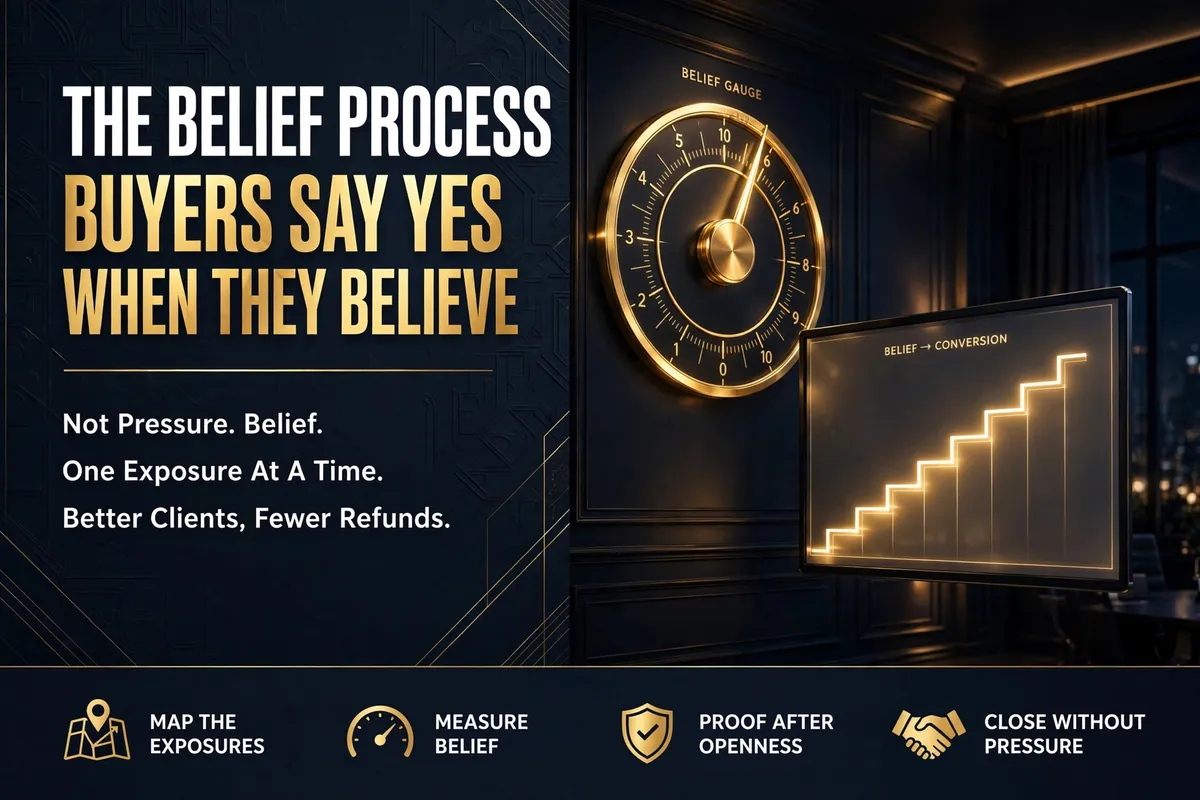
Think of belief like a dial with numbers from 1 to 10. Every buyer has one. At 1, they have no interest. At 10, they are ready to decide today. Nobody is born at 10. People move up the dial one exposure at a time.
An exposure is anything that shows the buyer what is possible. A video. A teaching call. A story from a happy client. A working meeting where real problems get solved. Each exposure turns the dial a little higher.
Pitching on the spot tries to jump the dial from 3 to 10 in one conversation. That is pressure, and buyers feel it. The belief process does the opposite. It lines up exposures in order, lets each one do its job, and allows the buyer to arrive at 10 on their own. When they do, the sale is not a push. It is a decision they already made.
This is why proof always comes after openness, never before. A testimonial shown too early feels like a sales trick. The same testimonial shown after the buyer agreed to take a look feels like evidence. The order is the whole game.
Why This Matters for Business Owners
A business without a belief process runs on the owner's energy. Every sale depends on a live conversation going well. Every week starts at zero. That works until it does not, and it never scales, because the owner's time does not scale.
A business with a belief process runs on a system. The presentation does the explaining. The follow-up does the measuring. The owner steps in at the moments that matter most, instead of carrying every moment by hand. That is the difference between a business that depends on hustle and a business that compounds.
The quality of the client changes too. Buyers who decide at belief level 10 rarely get buyer's remorse. They paid in full because they were certain, not because they were pressured. Certain clients are easier to serve, stay longer, and refer more often. Rushed clients do the opposite: they question the price, delay payment, and leave early. The process does not just change how many deals close. It changes which deals close.
There is also a quiet math to it. Pitching on the spot wins some and loses more, and the losses are invisible. The prospect who said "let me think about it" and never came back is gone forever. A belief process keeps those people in motion. They are not pushed, they are exposed, followed up with, and measured. Many of them buy later. Without the process, later never comes.
For owners who feel they cannot step away from sales, this is the way out. The process holds the relationship while the owner is busy. It follows up when the owner forgets. It presents when the owner is asleep. That is what a system is: work that continues without the worker.
Step-by-Step Breakdown
The process has six parts. Each one has a job, and the order matters.
Step 1: Map the exposures.
Before anything is built, the owner lists what a prospect sees first, second, and third. The first exposure earns attention. The middle exposures build understanding. The final exposure makes the offer feel obvious. Most businesses have these pieces scattered. Mapping them in order turns noise into a sequence.
Step 2: Separate the invite from the pitch.
The first conversation has one job: find out if the person is open to taking a look. Nothing is sold here. No price is mentioned. No offer is described. The only question is whether they will agree to see the presentation. This protects the relationship, because nobody feels ambushed.
Step 3: Let the presentation do the selling.
The presentation can be a video, a webinar, a teaching call, or a series of working meetings. Its job is to raise belief while the owner is not in the room applying pressure. One rule governs this step: the exposure is never interrupted. No check-in texts while they watch. No calls in the middle. Interrupting breaks the spell, and the one sentence that would have closed them might be the one they miss.
Step 4: Follow up by measuring belief.
After the presentation, the follow-up is a measurement, not a chase. The owner asks where the buyer stands, on a scale from 1 to 10. A 1 means no interest, and that is useful information. A 10 means they are ready today. The 7 to 9 range is where conversations close deals: the buyer is close, and a straight talk about what is holding them back finishes the job. Without the scale, follow-up is guessing. With it, follow-up is reading a dial.
Step 5: Move fast after yes.
Belief fades with time. A buyer at a 10 today can be at a 6 next week, not because anything changed, but because life filled the space. So the next step is always booked within a day of the yes: the onboarding call, the kickoff, the plan. Speed here is not pressure. It is protection of a decision the buyer already made.
Step 6: Share proof after openness, never before.
Testimonials, case studies, and stories are the most powerful tools in the process, and they are also the most misused. Shown before the buyer agrees to look, they trigger skepticism. Shown after, they confirm what the buyer is already starting to believe. Patience with proof is what makes proof work.
Strategic Insight
The timeless principle is this: people do not buy when they are convinced. They buy when they believe.
Convincing is pressure applied from the outside. It works on some people, some of the time, and it leaves a residue. The buyer remembers being pushed, and that memory becomes doubt, refund requests, and bad reviews.
Belief is certainty built from the inside. It is slower. It is built one exposure at a time, in the right order, without interruption. And it leaves no residue, because the buyer convinced themselves. A buyer who convinced themselves does not ask for a refund. They ask what is next.
This is why the best salespeople often look like they are barely selling. They are not pushing the dial. They are lining up exposures, measuring belief, and letting the process do the heavy lifting. The sale is the effect. The belief is the cause. Businesses that work on the cause stop struggling with the effect.
Common Mistakes to Avoid
Pitching on the first call. The first conversation is for openness, not for offers. Pitching early spends trust that has not been earned yet, and it is the fastest way to turn a warm prospect cold.
Sharing proof too early. Testimonials and results shown before the buyer agrees to look feel like hype. The same proof shown at the right moment feels like confirmation. Timing is what separates the two.
Interrupting the presentation. Texting or calling while a prospect is watching the presentation seems helpful. In practice, it breaks focus at exactly the wrong moment. The reminder goes out before, then there is silence until it is done.
Treating follow-up as nagging. Follow-up without a belief scale is just checking in, and buyers can feel the difference. Measuring where they stand turns follow-up into a useful conversation instead of an awkward one.
Waiting to build the process. The most expensive mistake is postponing the setup because selling feels more urgent. In practice, the businesses that pause for a day to build the sequence end up selling with less effort than the ones that never stop pitching.
FAQ
What exactly is the belief process? It is the sequence of exposures that moves a buyer from first contact to confident decision. Each exposure raises belief, and the sale happens when belief is high enough, not when pressure is high enough.
How is this different from a sales funnel? A funnel is a structure. The belief process is what happens inside the structure. Funnels move people through pages. The belief process moves people through certainty. A funnel without it leaks. With it, the funnel converts.
How long does it take to set up? In practice, the core setup often takes a single focused day: one presentation, one mapped sequence, one follow-up method. It grows from there, but the first version does not need to be perfect to start working.
Does this work for products, services, or both? Both. Anything with a considered purchase, where the buyer needs to feel sure before spending, runs on belief. The exposures change shape, but the dial works the same way.
What if a prospect says no? A no at a low belief number is information, not failure. It means more exposures are needed, or the fit was never there. The process keeps the relationship warm, and some of today's noes become next quarter's yeses.
How do you know when someone is ready? You ask. The 1-to-10 scale turns a feeling into a number. At 10, they are ready today. At 7 to 9, a direct conversation about what is left usually closes it. Below that, more exposure is the answer, not more pressure.
Can a small business do this without a team? Yes. The process was designed to run without constant attention. One owner with one presentation and a simple follow-up habit gets most of the benefit. Teams make it faster, not possible.
Need help with scaling your business?
If you want Resurreccion Media to look at your business and give you clarity on your next step, apply for Private Advisory. We help 7-9 figure founders and companies scale.
Take the Free Customer-Worth Calculator
Most owners guess what a customer is worth. The ones who know their numbers make better decisions about content, offers, and growth. Our free calculator shows your average order value, purchase frequency, and lifetime customer value in under 60 seconds. Run your numbers here.
Subscribe to Our YouTube Channel
We post simple, clear videos that help business owners grow without confusion. You can find us at @resurreccionmedia.


