
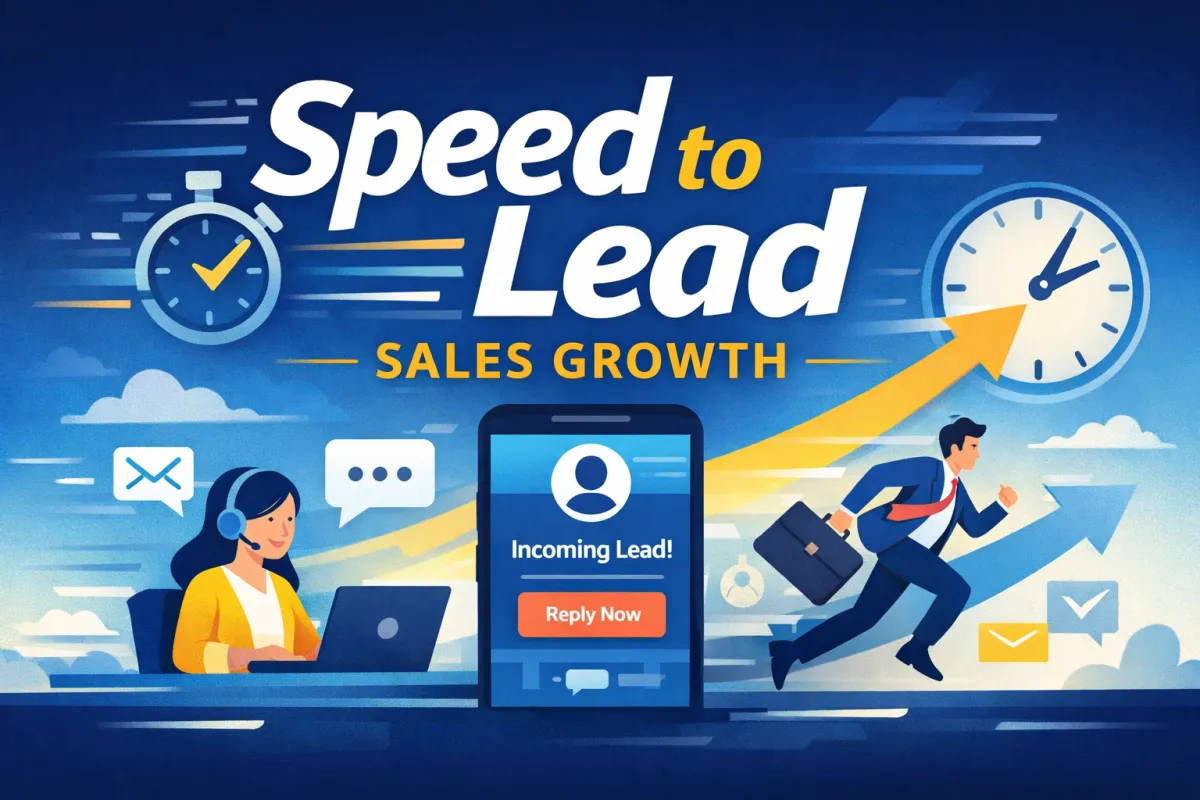
The Importance of Speed to Lead in a World That Expects Now
Business now operates in a world built around instant action. Messages send immediately. Purchases happen in seconds. Decisions form faster than ever.
When a potential customer reaches out, the clock starts right away.
Speed to lead reflects how closely a business aligns with how people already behave. In practice, companies that respond quickly close more deals, earn trust faster, and scale with less friction.
Proof From Real-World Experience
Across industries, the same pattern appears again and again. When businesses respond to new leads faster, deals close more often. When replies take hours or days, interest fades.
Over time, companies that move quickly develop a reputation for being reliable and easy to work with. That reputation compounds into more referrals, smoother sales conversations, and stronger customer retention.
Inside one fast-growing organization, The Knowledge Society, leadership examined what the top customer service companies had in common. The answer was not tone, scripts, or personality. It came down to one operational advantage, response speed.
The highest performers responded almost immediately.
A simple standard changed everything. Every phone call or email received a response within two minutes. At the time, the inbox held thousands of unanswered messages. After adopting this rule, the backlog dropped to zero. From that point forward, every message received attention within two minutes or less.
The impact extended beyond sales. Customers felt supported. Trust increased. Internal standards rose. Team morale improved as expectations became clear and execution matched them. Operational excellence reshaped company culture.
Sales followed naturally, not through pressure, but through presence.
What Speed to Lead Means
Speed to lead refers to how fast a business responds when someone raises their hand.
That moment can take many forms:
A contact form submission
An email inquiry
A phone call
A direct message
A booking request
From the customer’s perspective, this moment is active. The problem is top of mind. The intent is real. Comparisons are happening in real time.
From the business side, this moment is fragile. Delay creates space for doubt, distraction, and competitors.
Speed to lead is not about closing instantly. It starts with acknowledgment. A short response signals attention. Attention signals respect. Respect keeps the conversation alive.
Why This Matters for Business Owners
Business owners often focus on traffic, ads, content, and offers. Those inputs matter. Speed quietly determines whether they convert.
In practice, this is what often happens.
A potential customer reaches out to three businesses.
One replies within minutes.
One replies hours later.
One replies the next day.
The fastest responder frames the conversation. The others enter a discussion already happening somewhere else.
Fast response tends to do three things at once.
First, it captures intent while it is fresh. Interest decays quickly. Fast replies meet people at peak motivation.
Second, it signals operational competence. When a business responds quickly, customers assume delivery will run smoothly.
Third, it reduces perceived risk. Silence creates uncertainty. Speed creates confidence.
Over time, this compounds. Businesses known for fast response experience fewer objections, stronger referrals, and higher close rates without changing their offers.
How Speed to Lead Works in Practice
Speed rarely comes from working longer hours. It comes from mindset, structure, and systems working together.
Response Time Becomes a Standard
In high-performing teams, response speed is visible and shared.
When speed becomes a standard, behavior aligns naturally. Urgency stops being debated. Execution becomes consistent. Friction disappears.
Acknowledgment Stays Separate From Resolution
Fast response does not require instant answers.
A short acknowledgment preserves momentum:
“We received this.”
“We are looking into it.”
“You are in the right place.”
Trust remains intact while real work happens behind the scenes.
Coverage Rules Stay Simple
Speed breaks down when ownership is unclear.
Clear rules restore it:
Who monitors the inbox
Who answers calls
What happens during meetings or breaks
Defined coverage makes speed predictable.
Tools Reduce Friction
Slow systems create slow responses.
High-performing teams reduce friction by centralizing communication, using shared inboxes, and avoiding unnecessary tools. When messages are easy to see, they get answered faster.
What Gets Measured Improves
Teams that care about speed track it consistently. Visible metrics reinforce standards and surface breakdowns early, long before customers feel them.
The Strategic Insight Behind Speed
Speed works because it aligns with human behavior.
People reach out when a problem is active. Fast responses meet that emotional window. Slow responses miss it.
This is not aggression. It is presence.
In practice, speed becomes a trust signal. Trust reduces friction. Reduced friction increases conversion.
The fastest responder often wins, not because they are better, but because they arrived first.
Common Mistakes That Break Speed to Lead
Waiting for the perfect reply
Polished responses sent late lose to simple responses sent early.Relying on one person
Speed collapses when everything routes through a single inbox owner.Treating inquiries as interruptions
High-performing teams treat inquiries as the work.Ignoring internal standards
Without clear expectations, speed erodes quietly.Confusing automation with responsiveness
Automation helps, but human acknowledgment still matters.
Frequently Asked Questions
Does speed to lead matter for small businesses?
Yes. Smaller teams often win precisely because they move faster.
Is fast response possible without burnout?
Yes. Clear systems reduce stress rather than increase it.
What if instant response is not possible?
Acknowledgment still preserves momentum.
Does speed matter more than price?
Often. Speed reduces comparison shopping.
Can speed improve customer retention?
Consistent responsiveness strengthens long-term trust.
The Hidden Effect on Culture and Standards
Speed to lead does more than increase sales. It reshapes internal behavior.
When teams move quickly, ownership increases, accountability improves, and pride in execution grows.
High standards tend to spread. Speed becomes a reflection of how the organization thinks, not just how it replies. This cultural shift often outlasts any single system.
Final Perspective
The world already operates at near-instant speed. Customers adapted first. Businesses that align with this reality benefit quietly and consistently.
Speed to lead is not a tactic. It is an operating posture.
Companies that respond fast tend to grow faster, not because they chase growth, but because they respect momentum when it appears.
📩 Need Help With Your Specific Situation?
If you want Resurreccion Media to look at your business and give you clarity on your next step, reach out to us.
We help founders, service businesses, companies, and creators build content marketing systems that scale.
📊 Take the Free Growth Scorecard
Get an instant score that shows your bottlenecks and next moves.
You’ll receive a free business audit the moment you finish.
It takes less than five minutes.
(Click here to get your Scorecard)
▶️ Subscribe to Our YouTube Channel
We post simple, clear videos that help business owners grow without confusion.
Find us at @resurreccionmedia.


