Never Rely on One Platform for Distribution: The Hidden Risk Business Owners Miss
Most businesses do not fail because their product is bad.
They fail because their attention pipeline breaks.
Distribution looks stable right up until it isn’t. One platform works, leads come in, and growth feels predictable. Then reach drops. Accounts freeze. Traffic slows. Sales pause. The business did not change, but the platform did.
This article explains why relying on a single platform quietly limits growth, weakens leverage, and increases risk over time. It also explains what tends to work in practice when businesses spread distribution across multiple channels and prioritize what they actually own.
Proof From Real-World Experience
When businesses rely on one platform for visibility, competitors slowly pass them. The competitors do not win because they are louder. They win because they are present in more places. Over time, that presence compounds into trust, recall, and authority.
Another pattern appears once buyers become more informed. Modern customers rarely buy after seeing one post or one page. They look. They search. They check multiple channels to confirm credibility. When a business exists in only one place, the research path ends early. The sale often goes elsewhere.
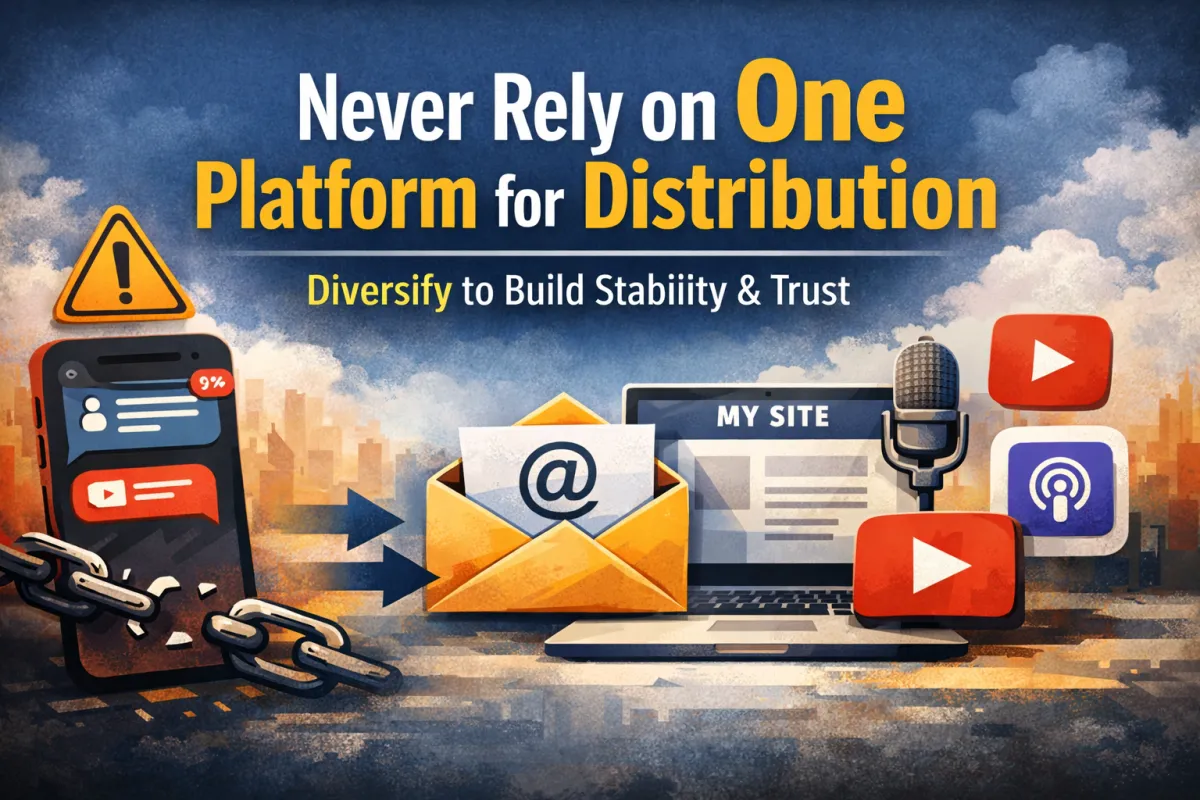
Platform outages reveal the risk clearly. When a major social platform went offline for hours, many businesses lost their only sales channel. No backup. No direct contact with their audience. Those with email lists or owned channels continued operating with little disruption. The difference was not effort. It was structure.
The operators who last longest share a common behavior. They publish consistently across channels, even before those channels produce money. They treat distribution as a system, not a campaign. Over time, visibility stacks. When one channel slows, others carry the load.
What This Means
Distribution is how people find you.
A platform is not the same thing as an audience.
When a business builds on one platform, it is borrowing attention. The platform controls reach, rules, and access. The business controls content only while the rules stay favorable.
Owning distribution means having a direct line to people who already trust you. Email lists, websites, and subscriber-based channels work differently. Access does not disappear overnight. Algorithms do not decide who sees what.
This difference sounds small. In practice, it changes how stable a business feels year after year.
Why This Matters for Business Owners
Growth depends on consistency. Consistency depends on control.
A single-platform business has fragile momentum. One update or policy shift can undo years of work. That fragility shows up in cash flow, planning, and confidence.
Multi-channel businesses behave differently. They attract customers from different paths. They stay visible even when one channel slows. They also benefit from how modern search and discovery systems work, where content is pulled from many sources, not one.
Buyers notice this too. A brand that appears in multiple places feels established. A brand that exists in one feed feels temporary. Trust builds through repetition across environments, not volume in one place.
Step-by-Step Breakdown: How Multi-Platform Distribution Works in Practice
1. Separate owned channels from rented platforms
Rented platforms provide reach. Owned channels provide control.
Email lists, websites, and long-form content hubs act as anchors. Social platforms act as feeders. When reach changes, owned channels keep working.
2. Choose a small number of active platforms
Spreading everywhere without structure creates burnout. Effective operators focus on a limited set of platforms where their audience already spends time.
Depth across a few channels beats shallow presence everywhere.
3. Use one core message across all channels
Consistency builds recognition. The message stays the same. The format changes.
A long article becomes short posts, videos, and emails. Each platform receives a version that fits its environment.
4. Publish even when monetization is unclear
Early distribution rarely pays immediately. The value appears later through compounding attention and trust.
Operators who stop early never reach that stage. Operators who continue quietly build leverage others cannot see yet.
5. Design systems, not posting habits
Systems remove emotion. Content calendars, repurposing workflows, and clear roles keep distribution running even during busy seasons.
When posting depends on motivation, gaps appear. When posting depends on systems, consistency stays intact.
Strategic Insight: Distribution Is Competitive Advantage
The quiet advantage of multi-platform presence is optionality.
When one channel declines, others remain. When a new opportunity appears, content already exists to support it. When buyers research, the brand shows up repeatedly.
This advantage compounds slowly. It rarely feels urgent. That is why many businesses ignore it until something breaks.
Common Mistakes to Avoid
Building entirely on one platform
Stability feels real until it disappears.Waiting for monetization before expanding
Distribution often pays later, not first.Posting randomly across platforms
Consistency matters more than volume.Ignoring owned channels
Borrowed attention cannot replace direct access.Stopping when growth feels slow
Compounding rewards patience, not urgency.
Frequently Asked Questions
Is using one platform ever enough?
It works temporarily. Long-term stability usually requires more than one channel.
Does this apply to small businesses?
Small businesses feel platform changes faster because margins are thinner.
Is email still relevant?
Direct communication remains one of the most stable forms of access.
How many platforms are practical?
A small, focused set tends to outperform wide, shallow coverage.
What matters more: quality or consistency?
Consistency creates trust. Quality keeps attention once trust exists.
Final Thought
Platforms change. Audiences move. Algorithms shift.
Businesses that survive do not chase every update. They build distribution systems that outlast them.
Visibility that exists in more than one place becomes harder to erase. Over time, that resilience turns into leverage competitors cannot easily copy.
📩 Need Help With Your Specific Situation?
If you want Resurreccion Media to look at your business and give you clarity on your next step, reach out to us.
We help founders, service businesses, companies, and creators build content marketing systems that scale.
📊 Take the Free Growth Scorecard
Get an instant score that shows your bottlenecks and next moves.
You’ll get a free business audit the moment you finish.
It takes less than 5 minutes.
(Click here to get your Scorecard)
▶️ Subscribe to Our YouTube Channel
We post simple, clear videos that help business owners grow without confusion.
You can find us at @resurreccionmedia.


