
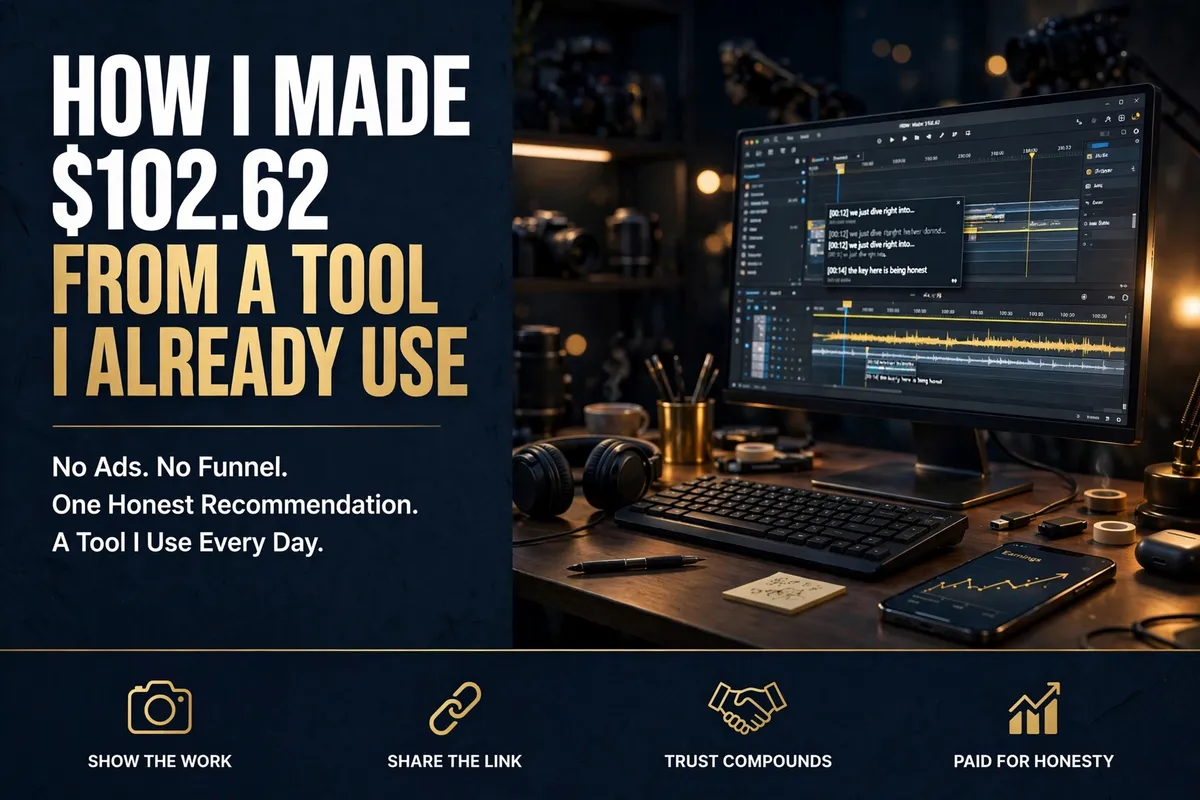
How I Made $102.62 Recommending a Tool I Already Use
I earned $102.62 by recommending a video editing tool I open every single day. I did not run ads. I did not build a funnel. I placed my link where I already publish, told the truth about a tool in my workflow, and the company paid me for the customers who came through it. Here is exactly how it works, and how the same move is sitting inside your business right now.
Proof From Real-World Experience
We edit video every day inside Resurreccion Media. Long videos for YouTube. Short clips for every platform. Talking head videos that need subtitles burned in so people can watch with the sound off. The tool we do a big part of that work in is called Descript.
One day I found out Descript runs an affiliate program through a company called Cello. The deal was simple. I get a link. Anyone who signs up for a paid plan through my link gets 50% off the Creator plan for two months. I earn a credit for each person who converts, up to $20 per conversion, which breaks down to $5.25 per month for each purchasing referral.
My thinking was simple: if I use the software anyway, and I can earn extra income from it, why not. So I shared my link in the places where I already talk about video. I did not change my content. I did not become a salesman. I just added the link where it fit and kept doing my work.
The credits added up to $102.62. It is not life-changing money, and that is not the point. It came from a tool I was already paying for and already using. I changed nothing about my workflow. The only new step was sharing the link wherever I could publish it.
That is the whole story. No launch. No audience of millions. Just a working tool, an honest recommendation, and a company that pays for referrals.
What This Means
Affiliate income is simple. A company gives you a special link. You share that link. When someone buys through it, the company pays you a cut. That is it.
Think of it like this. You eat at a great taco spot and tell three friends. They all go. The taco spot hands you twenty bucks as a thank you. That is affiliate income, except it happens through links on the internet and the payouts stack up over time.
Most people hear "affiliate marketing" and picture something shady. Pop-up ads. Fake reviews. Strangers shouting about products they have never touched. That version exists, and it gives the whole thing a bad name. But the clean version is just a referral with a paper trail. You like something. You say so. The company tracks who came from you and pays you for it.
One key detail: the money comes from the company's marketing budget, not from the buyer's pocket. The person who clicks your link pays the same price, or in the Descript case, they pay less, because my link knocks 50% off the Creator plan for the first two months. The commission is the company's cost of acquiring a customer they would have paid for with ads anyway.
Why This Matters for Business Owners
Every business owner already uses tools. Scheduling software. Email platforms. A CRM. A video editor. A payment processor. You pay for these things every month, and you have opinions about them from real daily use.
Almost all of those tools have affiliate or referral programs. Most owners never look. The money sits there, unclaimed, while they keep paying the monthly bill.
Here is why this matters more than the dollar amount. A check like this changes how you see your own workflow. Every tool you touch becomes a potential income stream. Every tutorial you film, every behind-the-scenes post, every "here is how I do X" becomes a chance to earn from work you were already doing. It turns documented work into compounding assets.
For a business owner, this is also one of the lowest-risk steps into detached income. You are not building a product. You are not hiring anyone. You are not spending on ads. You are pointing at something real, in public, with your name on it. If nobody clicks, you lost nothing. If they do, you get paid for honesty.
There is a second-order effect too. When you recommend tools publicly and honestly, your audience learns that your recommendations mean something. That trust compounds. Later, when you recommend your own paid offer, the trust is already there. The affiliate link is practice for selling with integrity.
Step-by-Step Breakdown
Step 1: List the tools you already pay for
Open your bank statements or your app subscriptions. Write down every tool your business pays for monthly. The scheduling app. The email tool. The editor. All of it. The list is usually longer than people expect.
Step 2: Mark the ones you would recommend anyway
Go down the list and ask one question about each tool: have I ever told another business owner to try this? The ones with a yes are your candidates. Real enthusiasm is the filter. If you would not recommend it for free, the affiliate version will sound fake, and people can tell.
Descript passed this test for me instantly. I edit long-form videos in it. I cut short-form clips in it. I add subtitles to talking head videos in it. I had already told other creators to try it before I knew the program existed.
Step 3: Check for an affiliate or referral program
Search the tool's name plus "affiliate program" or "referral program." Most software companies have one. The terms vary. Some pay cash. Some pay account credit, like Descript through Cello. Some pay a percentage for a year. Read the terms so you know exactly what you earn and when.
Step 4: Get your link and put it where you already show up
Sign up for the program and grab your link. Then place it in the spots where you already talk about your work. Video descriptions. A resources page. A post about your workflow. There is no need to build new content around the link. Attach the link to content that already exists.
My Descript link lives in my video descriptions and in articles like this one, right next to the places where I talk about editing. The link is https://descript.cello.so/X8bhxP7pcbM. It fits because the topic is already video.
Step 5: Disclose it plainly, every time
Say it is an affiliate link. One sentence is enough. Hiding it breaks trust, and in many places the law requires the disclosure anyway. The disclosure also helps: when people know you earn from it, and you still recommend the tool, the recommendation carries more weight, not less.
Step 6: Keep using the tool in public
This is the step most people skip. They share the link once and move on. The earnings come from continued, visible use. Every time you post a video with clean subtitles, every time you mention your editing flow, the link earns its keep in the background. The tool markets itself through your work.
Step 7: Check the numbers monthly
Log in once a month and look at clicks and conversions. You will learn which placements earn and which do nothing. Double down on what works. Cut what does not. My $102.62 came from a small number of placements I checked and kept.
Strategic Insight
The principle underneath all of this: money follows trust, and trust comes from documented real use.
Nobody buys because a link exists. People buy because a real person, doing real work, pointed at a real tool and said it works. The affiliate program just puts a tracking code on something humans have done forever: recommending what works.
This is why a small check matters more than the amount. It proves a loop: use something, show the work, share the link, get paid. Once that loop runs, it runs across every tool you touch. Each tool you add is easier than the last. Eventually it runs on its own.
Most business owners chase new income by adding new work. This move does the opposite. It extracts income from work already done. That is leverage, and leverage is the whole game.
Common Mistakes to Avoid
Promoting tools you have never used. People smell it instantly. One fake recommendation burns the trust that ten honest ones built. Only share what is actually in your workflow.
Hiding the affiliate relationship. If someone discovers the link pays you and you never said so, the story becomes the hiding, not the tool. One plain sentence up front prevents all of it.
Chasing the highest commission instead of the best fit. A 50% commission on a tool you do not use earns zero, because you will never mention it naturally. A small credit on a tool you open daily earns on autopilot.
Spamming the link everywhere. A link in every comment and DM reads as desperation. Place it where the topic already fits and leave it alone.
Quitting after week one. Affiliate income starts slow. The first credits from a new placement did not arrive the day I shared the link. The loop needs time and repeated exposure. Most people stop right before it starts working.
FAQ
What is affiliate marketing, in plain English? A company gives you a link. You share it. When someone buys through your link, the company pays you. It is a referral with tracking.
Do I need a big audience to earn affiliate income? No. You need trust with the people you do reach. A small audience that believes you outperforms a large one that does not. My $102.62 did not come from millions of views.
How much can a beginner realistically earn? It varies widely by tool and audience. Think in tens and hundreds at first, not thousands. The value early on is proving the loop works, not the dollar amount.
Is it honest to earn money recommending tools? Yes, when three things are true: you actually use the tool, you say the link pays you, and the buyer gets a fair deal. My Descript link meets all three. Readers get 50% off for two months, I earn a credit, and I edit every video in it.
What does Descript actually do? It is a video and audio editing tool. I use it to edit long-form videos, cut short-form clips, and add subtitles to talking head videos. The editing revolves around text, which makes cutting and captioning fast.
How do the Descript affiliate payouts work? Through their Cello program, I earn up to $20 in credit per conversion, which breaks down to $5.25 per month for each purchasing referral. Payouts are account credit, not cash. Check the current terms on their site, since programs change over time.
Full disclosure: the Descript link in this article (https://descript.cello.so/X8bhxP7pcbM) is my affiliate link. It costs you nothing extra. You get 50% off the Creator plan for two months, and I earn a credit when you sign up through it. I recommend it because it is the tool I edit every video with, not because of the credit.
Need help with scaling your business?
If you want Resurreccion Media to look at your business and give you clarity on your next step, apply for Private Advisory. We help 7-9 figure founders and companies scale.
Take the Free Customer-Worth Calculator
Most owners guess what a customer is worth. The ones who know their numbers make better decisions about content, offers, and growth. Our free calculator shows your average order value, purchase frequency, and lifetime customer value in under 60 seconds. Run your numbers here.
Subscribe to Our YouTube Channel
We post simple, clear videos that help business owners grow without confusion. You can find us at @resurreccionmedia.


