
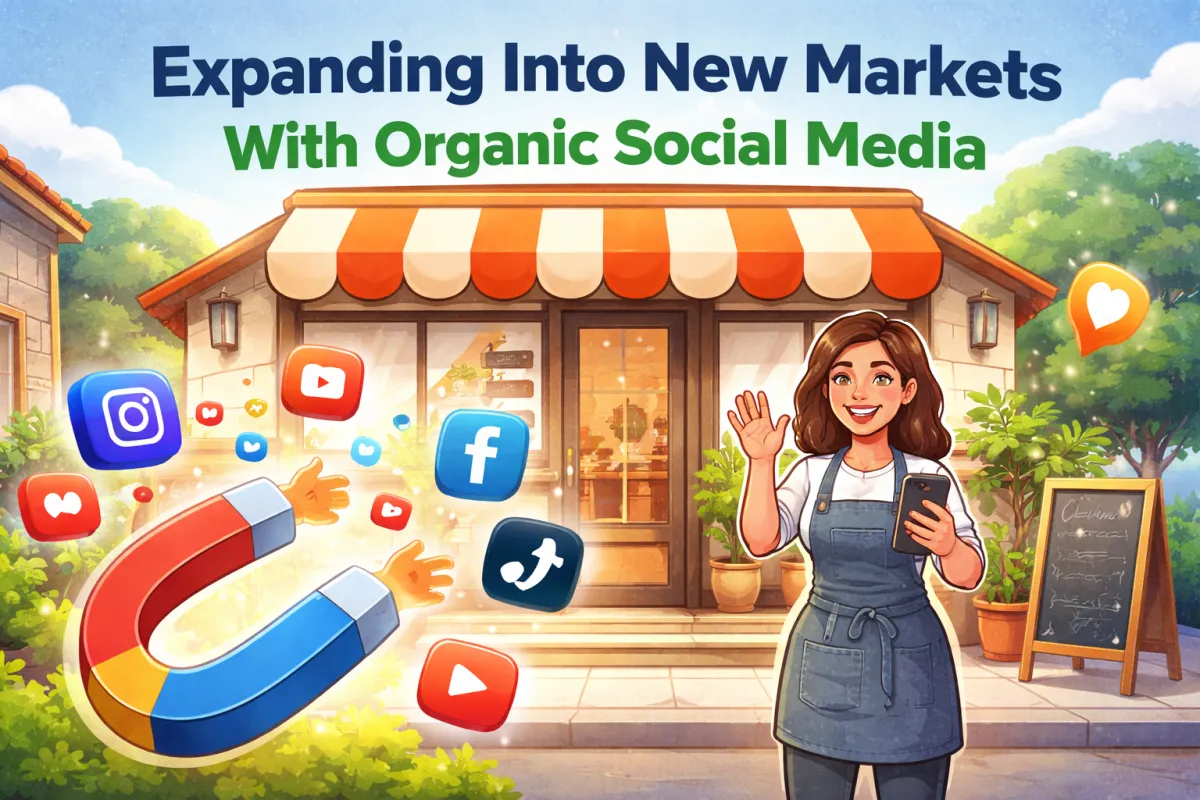
How Local Business Owners Expand Into New Markets Using Organic Social Media Marketing
Local business owners often believe expansion requires a second location, paid ads, or outside investors. In reality, many expansions begin with something far simpler: organic social media marketing. When used correctly, it allows a local brand to reach new cities, new states, and sometimes even a national audience without paying for reach.
This article explains what actually happens when local businesses attempt to expand through organic social media, what separates those who gain traction from those who stall, and how the process works in the real world.
Proof From Real-World Experience
When local businesses attempt to grow into new markets using organic social media, two patterns tend to emerge.
Some never start. The idea feels unfamiliar. Marketing feels complex. Expansion feels like something only large companies attempt. So they stay local, even when demand exists elsewhere.
Others begin posting consistently. Leads increase. Visibility grows. Then something breaks.
The most common break point is operations. In many cases, the marketing works. Attention rises. Inquiries increase. But there are no systems for onboarding new clients. There is no team structure. There is no scalable process. The business becomes overwhelmed, and growth stalls.
In one service-based company based in California, organic social media built a brand that reached far beyond its physical location. The content demonstrated expertise, built trust, and showed the face behind the company. Over time, the audience expanded. Eventually, a client traveled from Florida to California to become a paying customer. The reach was global. The business was local. The bridge was organic social media marketing.
The difference was not luck. It was consistent demonstration of expertise, visible leadership, and educational video content that packaged authority into simple explanations.
That pattern repeats more often than most realize.
What This Means
Organic social media marketing means creating and publishing content without paying for distribution. No ads. No boosted posts. No paid reach.
For a local business, this often looks like:
Educational videos
Behind-the-scenes content
Client transformations
Process breakdowns
Clear explanations of common problems
When done correctly, this type of content does three things:
It proves competence.
It builds trust.
It creates familiarity.
People rarely travel across states for a service unless they trust the brand. Trust is built through repeated exposure and demonstrated expertise.
Local businesses that expand into new markets through organic social media are not going viral. They are building authority in public.
Over time, geography becomes less important.
Why This Matters for Business Owners
Most local businesses believe growth requires physical expansion first. A new office. A new storefront. A new team in another city.
Organic social media changes the order.
First comes visibility.
Then comes demand.
Then comes expansion.
When demand appears in new markets before infrastructure exists, the business owner has leverage. They can:
Test demand before opening a second location
Offer remote or hybrid services
Travel for premium clients
License systems
Build partnerships in new regions
Without demand, expansion is a gamble.
With visible demand, expansion becomes a decision.
However, when marketing outpaces operations, stress replaces opportunity. That is where many local businesses struggle. They attract attention but lack systems to absorb growth.
Marketing opens the door. Systems keep it open.
Step-by-Step Breakdown: Expanding Into New Markets Through Organic Social Media
Step 1: Clarify the Core Expertise
Expansion begins with clarity.
What problem does the business solve better than competitors?
Effective operators define:
The specific problem
The type of client
The outcome delivered
Content becomes easier when the message is precise.
Vague businesses attract vague attention.
Clear businesses attract serious buyers.
Step 2: Demonstrate Expertise Publicly
Content that expands reach tends to educate.
It answers questions prospects already have.
It explains mistakes.
It shows the process.
It simplifies complexity.
Video often performs well because it builds trust faster. Seeing the face behind the business reduces uncertainty.
Demonstration builds authority.
Claims create skepticism.
Businesses that grow into new markets consistently show what they know instead of talking about how good they are.
Step 3: Show the Human Behind the Brand
Trust compounds when the audience sees the operator.
Showing the face of the founder or team does several things:
Humanizes the brand
Builds connection
Reduces perceived risk
Differentiates from faceless competitors
In many cases, clients choose familiarity over proximity.
They may live in another state.
They may travel for service.
They may hire remotely.
Connection often outweighs geography.
Step 4: Package Value Into Educational Video Content
Short, clear, educational videos tend to outperform random posting.
Effective content often includes:
A common problem
A simple explanation
A practical example
A clear outcome
This format signals expertise without sounding promotional.
When viewers learn something valuable, they return. When they return repeatedly, trust forms. When trust forms, distance becomes less relevant.
Step 5: Build Simple Systems Before Growth Accelerates
When attention grows, chaos can follow.
Leads increase.
Messages pile up.
Scheduling becomes messy.
The first operational cracks appear here.
Businesses that expand successfully usually implement:
Clear onboarding processes
Defined service packages
Response systems
Team training
Documented workflows
Marketing without systems creates pressure.
Marketing with systems creates leverage.
Step 6: Watch for Signals From New Markets
Expansion rarely starts with a formal announcement.
It often begins with signals:
Inquiries from other states
Requests for remote services
Questions about availability
Comments from distant viewers
These signals indicate demand.
Smart operators treat these signals as data. They refine messaging toward those markets. They test offers. They validate before investing heavily.
Demand first. Expansion second.
Strategic Insight: Visibility Precedes Geography
A timeless principle applies here:
Markets respond to visibility before they respond to location.
When a business becomes known for solving a specific problem, people seek it out even if travel is required.
Local businesses that think globally through content often create a new category for themselves. They move from local provider to recognized expert.
Once expertise becomes visible at scale, the definition of local changes.
Geography limits awareness.
Content expands awareness.
When awareness expands, opportunity follows.
Common Mistakes to Avoid
1. Posting Without a Clear Message
Random content attracts random attention. Without a defined problem and outcome, expansion efforts stall.
2. Hiding Behind Graphics Instead of Showing a Face
Faceless brands struggle to build trust in competitive markets.
3. Ignoring Operational Capacity
Increased demand without systems creates overwhelm and delays.
4. Treating Social Media Like Entertainment Instead of Education
Trends fade. Demonstrated expertise compounds.
5. Waiting for Perfection Before Publishing
Clarity improves through action. Silence creates invisibility.
Frequently Asked Questions
Can a local business really attract out-of-state clients organically?
Yes. When expertise is visible and trust is built over time, distance becomes less important. Authority travels through content.
What platforms work best for organic social media marketing?
Platforms that support educational video and consistent publishing tend to perform well. The key factor is consistency and clarity, not platform selection alone.
How long does it take to see results?
Organic growth compounds gradually. Early traction often appears in engagement and inquiries before revenue shifts.
What if the business cannot handle more clients?
This is a systems issue, not a marketing issue. Expansion requires operational preparation alongside content production.
Is paid advertising required to expand into new markets?
Paid advertising can accelerate visibility, but organic content alone can generate demand when executed consistently and strategically.
Does this work for service-based businesses only?
Service-based businesses often see strong results because expertise can be demonstrated easily. However, product-based businesses can also expand reach by educating buyers.
Final Perspective
Local businesses no longer rely only on foot traffic or local word-of-mouth. Organic social media marketing allows expertise to travel further than physical locations.
Some businesses never start because the process feels unfamiliar. Others start but stall when operations fail to scale.
Those who grow into new markets through organic content tend to do three things consistently:
Demonstrate real expertise
Show the human behind the brand
Build systems before growth overwhelms them
When visibility expands first, geography follows.
Expansion becomes a byproduct of authority.
📩 Need Help With Your Specific Situation?
If you want Resurreccion Media to look at your business and give you clarity on your next step, reach out to us.
We help founders, service businesses, companies, and creators build content marketing systems that scale.
📊 Take the Free Growth Scorecard
Get an instant score that shows your bottlenecks and next moves.
You’ll get a free business audit the moment you finish.
It takes less than 5 minutes.
(Click here to get your Scorecard)
▶️ Subscribe to Our YouTube Channel
We post simple, clear videos that help business owners grow without confusion.
You can find us at @resurreccionmedia.


